



Tours in Grundarfjordur


Cruising to Grundarfjordur in a group?
Skip the crowded ship excursion bus. One dedicated planner will design a private shore experience around exactly what your group wants — coordinated from first enquiry to the moment you're back on board. More memorable, more flexible, and more affordable than you might expect. Spend less time organising, more time enjoying.
Explore Group Travel →Cruising to Grundarfjordur
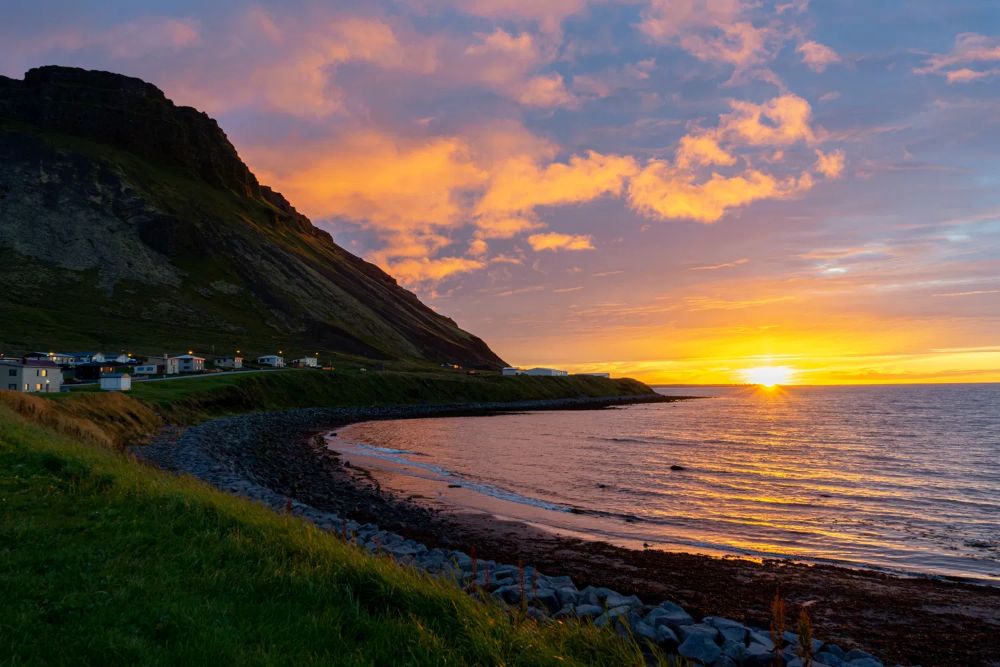
Grundarfjordur is a small fishing town of around 900 people situated on the north coast of the Snaefellsnes Peninsula, approximately 180 kilometres north of Reykjavik. Cruise ships calling here find themselves in one of Iceland's most photogenic corners: the town sits directly beneath Kirkjufell, the arrow-shaped mountain that has become Iceland's single most photographed natural landmark, its distinctive silhouette reflected in the adjacent river and waterfall. The surrounding landscape belongs to a different category of wild entirely.
The Snaefellsnes Peninsula stretches roughly 90 kilometres from east to west, tapering to the Snaefellsjokull glacier-capped volcano at its tip — a UNESCO-listed national park and the location Jules Verne immortalised in Journey to the Centre of the Earth. The peninsula has been called 'Iceland in miniature' for good reason: its 90-kilometre length packs in nearly every geological feature the country is famous for — glaciers, lava fields, sea cliffs, black sand beaches, volcanic craters, hot springs, and ancient fishing villages.
The scale of the landscape here is genuinely humbling. Roads wind past ancient lava flows colonised by emerald moss, past basalt rock formations carved by Atlantic storms, past lighthouses perched above churning surf. Birdlife is extraordinary: puffins nest on coastal cliffs in summer, Arctic terns dive near shorelines, and golden plovers and Arctic foxes are sometimes spotted in the interior. The combination of geological drama and biological richness makes Snaefellsnes one of the most rewarding natural environments anywhere on the European cruise circuit.
With three Venture Ashore tours dedicated to the peninsula, cruise passengers calling at Grundarfjordur have well-crafted routes for experiencing its highlights — whether that means guided interpretation of the geology and folklore, or a self-directed audio journey through landscapes that seem to belong to another planet entirely.
Top things to do in Grundarfjordur on a cruise stopover
Kirkjufell: Iceland's Most Iconic Mountain
Rising 463 metres directly above Grundarfjordur's harbour front, Kirkjufell (Church Mountain) is the most photographed natural landmark in Iceland and one of the most recognisable mountain profiles in the world. Its distinctive arrow shape, virtually symmetrical from certain angles, creates a silhouette that seems almost too perfect to be natural. The waterfall of Kirkjufellsfoss at its base — cascading over multiple tiers into a river that reflects the mountain above — provides the foreground that has made this composition iconic in travel photography. In summer, the long Icelandic light turns the hillsides golden at midnight; in winter, the Northern Lights occasionally frame the peak in curtains of green and purple. From the pier in Grundarfjordur, the mountain is visible immediately upon arrival — a dramatic introduction to what the peninsula holds.
Snaefellsjokull Glacier and National Park
At the far western tip of the Snaefellsnes Peninsula, the Snaefellsjokull glacier caps a 1,446-metre stratovolcano in a permanent mantle of ice. Jules Verne chose this spot as the entrance to the centre of the Earth in his 1864 novel, and standing at the glacier's edge, it is not difficult to understand why. The surrounding national park, Iceland's smallest, encompasses a landscape of extraordinary variety: ancient lava flows draped in luminous green moss, coastal sea stacks sculpted by Atlantic waves, black sand beaches, and birdlife-rich cliff faces. On clear days, the glacier is visible from Reykjavik across the bay — a distant white pyramid rising from the sea. Closer, it dominates the sky and the horizon in a way that few natural features anywhere can match.
Djupalonssandur: The Black Pebble Beach
Djupalonssandur is one of the most atmospheric beaches on the Snaefellsnes Peninsula — a broad black pebble cove backed by dramatic lava rock formations and fronted by the raw Atlantic. The beach carries a melancholy historical weight: scattered along its shoreline are the rusting remains of a British trawler that foundered here in 1948, left in place as a memorial to the lives lost. Four lifting stones at the beach entrance date to the era when local fishermen tested their strength before being permitted to join a crew — a stone unlifted meant a berth unearned. The combination of jet-black pebbles, jagged lava outcrops, crashing surf, and the distant silhouette of the glacier creates a scene of elemental power that many visitors describe as the single most memorable stop on the peninsula.
Arnarstapi and the Coastal Lava Formations
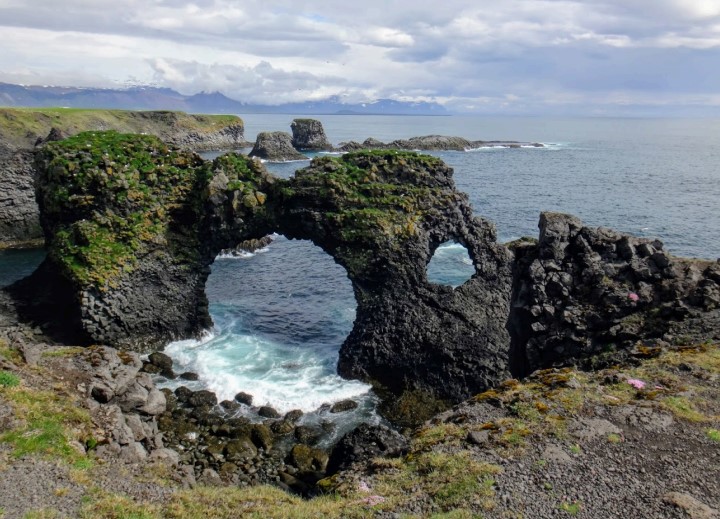
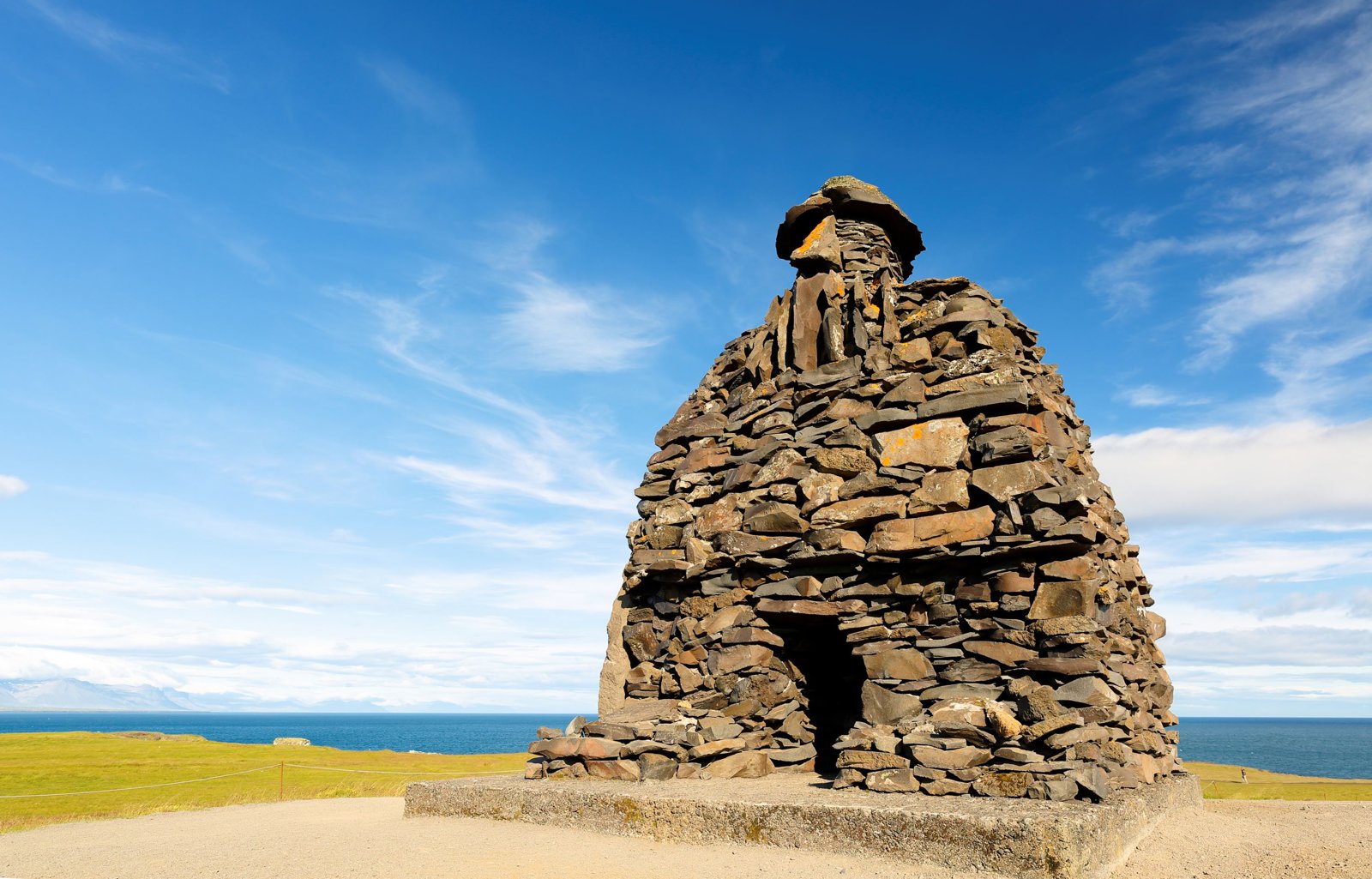
The small fishing hamlet of Arnarstapi sits at the junction of a vast lava field and the sea, its harbour carved from volcanic rock and its surroundings shaped by millennia of wave action into a sculptural landscape of arches, sea stacks, and blow-holes. A marked coastal walking path connects Arnarstapi to the neighbouring village of Hellnar along basalt cliffs alive with seabirds in summer — Arctic terns, fulmars, and kittiwakes nest in the rock faces, creating a cacophony of activity above the swell. The stone arch of Gatklettur — a natural sea arch through which the ocean surges — is among the most dramatic coastal features on the peninsula. A large statue of the mythological figure Bardur Snaefellsas, half-man, half-giant, stands guard at the Arnarstapi harbour, lending the place a quality of ancient, otherworldly presence.
The Lava Fields: Iceland's Geological Theatre
The interior and coastline of the Snaefellsnes Peninsula are defined by lava fields of various ages, each with its own distinctive character. Some are ancient enough to have been colonised by a thick carpet of moss — the Berserkjahraun lava field, named after two Viking berserkers according to the Laxdaela Saga, stretches across the northern peninsula in mounds and ridges of moss-covered stone that glow electric green in summer light. Other fields are more recent and rawer, their fractured black surfaces still largely bare, stretching toward the sea in frozen waves of volcanic rock. Walking among them, with the glacier visible above and the Atlantic audible below, gives a visceral sense of Iceland's geological youth — a landscape still actively forming, still expressing the forces that created it.
Stykkisholmur: Iceland's Most Charming Harbour Town
On the northern coast of the Snaefellsnes Peninsula, the small town of Stykkisholmur offers a rare combination of Icelandic architectural charm, a working harbour, and a superb natural setting. Colourful timber houses climb the hillside above a harbour filled with fishing boats; the 19th-century Library of Water, created by conceptual artist Roni Horn, houses a permanent installation of water columns drawn from Iceland's glaciers. The volcanic island of Sugandisey, connected to town by a short causeway, provides a lookout over a bay scattered with small islands and home to nesting seabirds. The town's restaurant and café scene — modest but genuine — gives visitors a sense of everyday Icelandic life that larger tourist destinations cannot easily replicate.
Grundarfjordur travel tips
Dress for the Arctic Edge. Even in July, Snaefellsnes can be cold, windy, and wet. The glacier creates its own microclimate, and the exposed north-facing coast amplifies the Atlantic wind considerably. Thermal base layers, a windproof and waterproof outer shell, and warm headwear are not excessive preparation — they are necessary kit. Gloves are worth carrying even in summer. The weather can shift rapidly: brilliant sunshine at the pier can give way to low cloud and horizontal drizzle by the time you reach the glacier. The upside is that dramatic cloud formations and mist around the volcanic peak create an atmosphere that clear blue skies often cannot match.
Photograph Kirkjufell at Its Best. Kirkjufell and its associated waterfall Kirkjufellsfoss are best photographed from the small parking area and footpath directly across the river from the mountain — a 5–10 minute walk from the town harbour. The classic composition places the triple-tiered waterfall in the foreground with the mountain rising behind. For the reflection shot, arrive at Kirkjufellsfoss itself and look across the river pool toward the mountain. The soft, diffused light of overcast Icelandic days often works better for this shot than direct sunlight, which can blow out the white water of the falls.
Respect the Landscape: Stick to Marked Paths. Iceland's moss-covered lava fields are among the most fragile ecosystems in the country. Icelandic moss grows only a few millimetres per year, and a single footprint can leave a visible scar for decades. At sites such as Djupalonssandur beach, the Snaefellsnes lava fields, and areas around the glacier, keeping to marked paths and designated viewing areas is not merely courteous — it is legally required in national park zones and ecologically critical everywhere else. The Environment and Natural Resources Agency enforces these rules, and fines apply. Photographing from paths and platforms does not diminish the experience.
The Midnight Sun and What It Means for Your Day. In June and early July, Grundarfjordur and the Snaefellsnes Peninsula experience the Midnight Sun — the sun remains above or just below the horizon around the clock, giving daylight at midnight and a perpetual golden-hour quality to the light from late evening onwards. If your ship is anchored overnight or late, the light at 10pm or 11pm is often the most beautiful of the entire day. Even on a standard day call, the light at the last hour ashore can be extraordinary. Check local sunrise and sunset times — in mid-June sunset occurs after midnight, making every hour a potential photography hour.
Iceland is Genuinely Cashless. Iceland has one of the highest rates of cashless payment in the world. Virtually every café, gift shop, tourist attraction, and fuel station accepts card payment, including contactless and chip-and-pin for foreign cards. Carrying Icelandic Krona is almost never necessary. Your ship's onboard account currency will likely be USD or EUR — simply use your regular bank card ashore. Be aware that some international banks charge foreign transaction fees; a no-fee travel card is worth considering before departure.
Wildlife: Look Up, Look Out, Look Down. The Snaefellsnes Peninsula is outstanding for wildlife in summer. Puffins nest on coastal cliffs from late April through August — Arnarstapi and the sea cliffs west of Hellnar are reliable locations. Arctic terns nest near freshwater and will dive-bomb humans who approach their nests; do not be alarmed, but do walk with purpose through nesting areas. Seals haul out on rocks along the northern coast. Arctic foxes are occasionally spotted on the lava fields. Look up at cliff faces for nesting fulmars and kittiwakes; look down at rock pools and shoreline for oystercatchers and purple sandpipers. The peninsula's wildlife is unhurried and remarkably close.
Port Facts Every Cruiser Needs To Know
Grundarfjordur shore excursion FAQs
Grundarfjordur is a small fishing town of around 900 people on the north coast of Iceland's Snaefellsnes Peninsula. Cruise ships call here because the peninsula is one of Iceland's most celebrated natural landscapes — home to the Snaefellsjokull glacier, Kirkjufell mountain, dramatic lava coastlines, and black sand beaches. It provides access to a part of Iceland that is otherwise difficult to reach efficiently on a day visit from Reykjavik.
The immediate surroundings of Grundarfjordur — including views of Kirkjufell mountain and the Kirkjufellsfoss waterfall — can be explored independently on foot from the pier within an hour. However, the peninsula's key highlights (the glacier, Djupalonssandur beach, Arnarstapi, Stykkisholmur) are spread across 60–90 kilometres of road. Without a pre-arranged hire car picked up locally, independent access to these sites is very limited. Organised excursions provide the most practical solution.
Kirkjufell (Church Mountain) is a 463-metre isolated peak directly above Grundarfjordur harbour and Iceland's most photographed mountain. The classic photograph — mountain framed above the multi-tiered Kirkjufellsfoss waterfall — is taken from a marked footpath a 5–10 minute walk from the harbour, across the river from the mountain. The path is well-signed and easy to walk. Both sunrise and overcast conditions often produce the most dramatic images.
Snaefellsjokull is a glacier-capped stratovolcano at the western tip of the Snaefellsnes Peninsula. It rises to 1,446 metres and is the centrepiece of Snaefellsjokull National Park, Iceland's smallest national park. Jules Verne used it as the fictional entrance to the Earth's interior in his 1864 novel Journey to the Centre of the Earth. The glacier is visible from Reykjavik on clear days and is surrounded by lava fields, sea cliffs, and black sand beaches.
The cruise season here runs primarily June to September. Summers are cool rather than warm — expect 8–14°C, with frequent wind and the possibility of rain or low cloud at any time. The glacier creates its own microclimate and can be obscured by cloud when the rest of the peninsula is clear. Layers, waterproofs, and wind protection are essential regardless of the forecast. The weather is changeable but rarely severe in summer, and dramatic skies are part of the peninsula's character.
Yes. Puffins nest on sea cliffs along the Snaefellsnes Peninsula from late April through August, with the peak season being June and July. The sea cliffs near Arnarstapi and west of Hellnar are reliable locations. Puffins are typically seen in the morning and evening hours when they are most active around the nesting sites. They are surprisingly approachable but should not be disturbed.
Almost certainly not. Iceland is one of the world's most cashless societies — cards and contactless payment are accepted virtually everywhere on the peninsula, including small cafés, souvenir shops, and local services. International cards (Visa, Mastercard) work at all standard terminals. The only scenario where cash might theoretically be needed is at a very small roadside stall, which are rare. Withdrawing local currency is generally unnecessary.
Reykjavik offers urban Iceland — the capital city, the Golden Circle, the Blue Lagoon — all within well-developed tourist infrastructure. Grundarfjordur offers wild Iceland: dramatic volcanic landscapes, glacier access, remote coastal formations, and smaller communities away from the main tourist flow. Many itineraries include both; if yours does, treat Grundarfjordur as the natural complement to Reykjavik's cultural and geothermal experiences.
It is considered by many visitors to be the single most atmospheric stop on the Snaefellsnes Peninsula. The jet-black pebble beach, framed by dramatic lava formations and backed by views toward the glacier, has a raw, elemental quality that is hard to find elsewhere. The rusting wreckage of the Epine GY7 trawler, scattered across the beach since 1948, adds historical weight to an already powerful landscape. The ancient lifting stones add a human dimension to the geological drama.
In June and the first weeks of July, Grundarfjordur experiences near-continuous daylight — the sun dips only briefly below the horizon around midnight, bathing the landscape in a prolonged golden-hour light. If your ship is anchored in the fjord overnight or into the late evening, the light between 9pm and midnight is often extraordinary: Kirkjufell glowing amber above the darkening water, the glacier white against a pale sky. Even on a day call, late-afternoon light on the mountain and coastal formations is markedly more beautiful than midday.
Filters
Select a filter to refine results.
Tour Type
Tour Activity
 Cart
Cart
 USD
USD GBP
GBP AUD
AUD EUR
EUR CAD
CAD