



Tours in Hanoi


Cruising to Hanoi in a group?
Skip the crowded ship excursion bus. One dedicated planner will design a private shore experience around exactly what your group wants — coordinated from first enquiry to the moment you're back on board. More memorable, more flexible, and more affordable than you might expect. Spend less time organising, more time enjoying.
Explore Group Travel →Cruising to Hanoi
Hanoi does not announce itself — it unfolds. The capital of Vietnam is a city of compressed history, where French colonial mansions lean against shop-houses that have traded the same goods for five centuries, and where the smell of pho broth drifting from a pavement stall can stop you mid-stride at seven in the morning. To arrive here is to understand, almost immediately, that this is a place that has outlasted empires on its own terms.
The Old Quarter — 36 streets, each once dedicated to a single trade — remains the city's irreducible heart. Silk Street still sells silk. Paper Street still sells paper. The logic is medieval and somehow still intact, now threaded through with motorbikes in such numbers that crossing the road becomes its own art form: step out steadily, make no sudden movements, trust the flow to part around you. It does, invariably.
Beyond the commerce of the Old Quarter lies a city of lakes and temples. Hoan Kiem Lake sits at the centre of Hanoi's civic life — joggers at dawn, chess players at midday, couples at dusk — with the red-painted Huc Bridge arching toward Ngoc Son Temple on its small island. To the west, the Temple of Literature, Vietnam's first university, offers shaded courtyards and stone steles listing the names of doctoral graduates from the 11th century onward. The Ho Chi Minh Mausoleum, where the revolutionary leader lies in state, draws long, respectful queues and demands a certain solemnity of dress and manner.
Then there is the food — arguably the finest reason to come. Bun cha, the charcoal-grilled pork patty dish eaten with rice noodles and fresh herbs, is a Hanoi obsession. Banh mi from a street cart costs almost nothing and tastes extraordinary. Egg coffee, a Hanoi invention of whipped egg yolk and sweetened condensed milk poured over espresso, defies easy categorisation and demands to be tried. Eat early, eat often, eat wherever the plastic stools are fullest.
Top things to do in Hanoi on a cruise stopover
The Old Quarter: 36 Streets, Centuries of Trade
The Old Quarter's grid of narrow streets follows a logic laid down under the Ly dynasty — each lane named for the guild that once monopolised it. Today the pattern holds, improbably: Hang Bac (Silver Street) still clusters jewellers; Hang Ma (Paper Street) erupts in colour with paper votives and festival decorations. Walking here is immersive and occasionally overwhelming. The best strategy is to leave the main thoroughfares and push into the lanes running between them, where family workshops operate in spaces no wider than a corridor and the pace drops perceptibly. Early morning, before 8am, is when the Quarter belongs to its residents rather than its visitors.
Hoan Kiem Lake and Ngoc Son Temple
The lake at the centre of Hanoi's old city is less a landmark than a habit — something the city performs around it daily. The name means 'Lake of the Restored Sword', referencing the legend of Emperor Le Loi returning a magical blade to a giant turtle. Turtles do still live here, though rarely seen. The Huc Bridge, painted the deep red of lacquered wood, leads to Ngoc Son Temple on its small island — a compact, incense-fragrant shrine to the general Tran Hung Dao. Arrive before 9am to see the lake's surface still and the joggers completing their circuits in quiet concentration.
Temple of Literature: Vietnam's First University
Founded in 1070 and modelled on the Confucian temples of China, the Van Mieu complex served as Vietnam's principal centre of learning for over seven centuries. Five walled courtyards lead progressively inward, the architecture becoming more refined as you proceed. The most affecting feature is the collection of 82 stone steles, each mounted on a carved tortoise and inscribed with the names and home villages of doctoral graduates from examinations held between 1484 and 1779. Standing before them, you read the ambitions of a civilisation in miniature. The gardens are genuinely peaceful — a rare thing in central Hanoi.
Ho Chi Minh Mausoleum and the Ba Dinh Complex
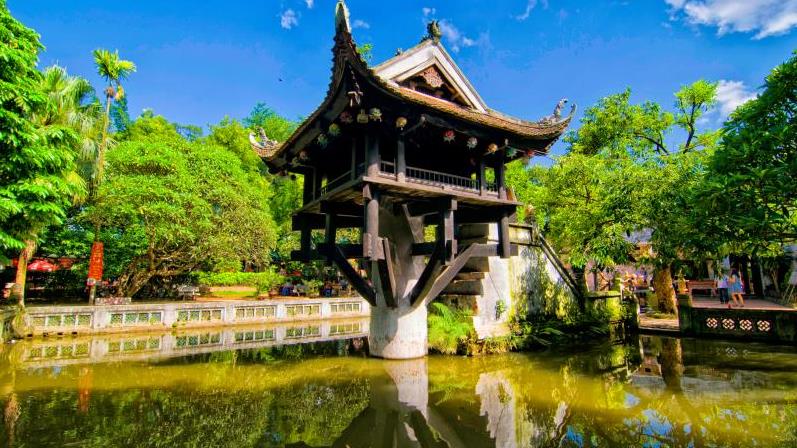
The mausoleum where Ho Chi Minh has lain in state since 1975 — against his own written wishes for cremation — is a place of genuine ceremony. Visitors queue in silence, are directed through in a continuous, unhurried procession, and must dress modestly (no shorts, no bare shoulders, no hands in pockets). The experience lasts only minutes but carries considerable weight. The surrounding Ba Dinh Square, where Ho Chi Minh read the Declaration of Independence in 1945, and the adjacent One Pillar Pagoda — a wooden shrine rising from a single stone column over a lotus pond — complete a morning well spent in this part of the city.
Street Food: Eating as the City Eats
Hanoi's food culture is specific, regional, and proud. Bun cha — grilled pork patties and sliced belly in a sweet-sour broth, eaten with vermicelli and a heap of fresh herbs — is the defining lunch dish, best tried at Bun Cha Huong Lien (made famous by an American television visit) or at any stall with a charcoal grill smoking on the pavement. Pho in Hanoi is cleaner and more restrained than its southern counterpart — a clear, deeply flavoured beef broth. For something singular, find a ca phe trung (egg coffee) at Cafe Giang, the original purveyor since 1946. A small, steep staircase leads to a room where elderly men read newspapers and the coffee arrives in a cup of warm water to maintain its temperature.
French Colonial Architecture: Hanoi's 'Paris of the East'
Between 1897 and 1954, French Indochina left Hanoi wide tree-lined boulevards, yellow neoclassical and Art Deco buildings, wrought-iron balconies, and a planned street grid contrasting sharply with the organic Old Quarter. The French Quarter — south and east of Hoan Kiem Lake — preserves this in concentrated form: the Hanoi Opera House (modelled on the Paris Opéra Garnier, completed 1911), the former Governor-General's Palace, diplomatic-quarter villas, and tree-lined Trang Thi Street. Walking the French Quarter reveals a city where two incompatible visions coexist — the French rational grid and the Vietnamese organic quarter — with residents navigating between them daily, parking motorbikes before neoclassical facades and setting up street food beneath wrought-iron verandas. This is what gives the 'Paris of the East' designation its actual basis. Best appreciated on foot in the early morning, before heat and traffic make the pavements less hospitable.
Hanoi travel tips
Cross the Road Like a Local. Traffic in Hanoi's Old Quarter appears impenetrable to anyone accustomed to traffic lights and pedestrian crossings. The technique is this: step off the kerb steadily and walk at a consistent pace — no hesitating, no running. Motorbikes are skilled at flowing around moving obstacles; it is stationary pedestrians who cause accidents. Make eye contact with approaching riders to confirm they see you. Within twenty minutes, most visitors have the rhythm. Zebra crossings exist but function only near major intersections.
Crossing Hanoi's Streets: The Most Useful Skill You Can Learn. Hanoi's traffic moves in a continuous, dense flow of motorcycles that appears impenetrable to visitors accustomed to light-controlled pedestrian crossings. The technique is counter-intuitive: step into the flow at a steady, predictable pace, maintain that pace, and let the traffic flow around you. Stopping suddenly or moving erratically is what causes near-misses. Locals cross exactly this way. Once learned, it becomes automatic — but the first crossing is consistently the most alarming moment of a first visit to Hanoi. Side streets are significantly calmer than the main thoroughfares and worth using wherever possible.
Dress for Temple Visits. The Ho Chi Minh Mausoleum has a strict dress code enforced without exception: no shorts, no sleeveless tops, no hands in pockets while inside. The Temple of Literature and Ngoc Son Temple also expect modest dress, though enforcement is less rigorous. A light scarf or shawl is the practical solution — useful for temples and for air-conditioned restaurants. The mausoleum is closed on Mondays, Fridays, and for several weeks annually (typically late September to early November) while Ho Chi Minh's body undergoes preservation maintenance.
Eat Where the Stools Are Lowest. Hanoi's most authentic food is served at pavement level — plastic stools perhaps 20 centimetres off the ground, shared tables, no menus. This is not a compromise; it is the correct setting. Look for places where the cooking happens in front of you, where the crowd is predominantly local, and where the turnover is constant. If a stall has been operating on the same corner for 30 years, that fact is usually handwritten somewhere on the wall. Prices at these establishments are a fraction of restaurant equivalents and the food is generally superior.
The Weekend Night Market Closes Streets. On Friday, Saturday, and Sunday evenings, the Old Quarter's main streets are closed to vehicles and given over to pedestrians and market stalls from around 6pm. The atmosphere shifts considerably — street performers, food vendors, families out for the evening. If your time in Hanoi includes a weekend evening, this is worth building into your plans. It also makes navigation easier, briefly, since the motorbikes are absent.
Carry Small Denominations. Street food vendors and market traders routinely struggle to break large notes — anything above VND 100,000 (approximately USD 4) can cause a genuine problem at a small stall. ATMs often dispense VND 500,000 notes. Break these at your hotel, at a convenience store (Circle K and Vinmart are common), or at a sit-down restaurant before heading into the market areas. Small notes make every transaction faster and more comfortable for both parties.
Port Facts Every Cruiser Needs To Know
Hanoi shore excursion FAQs
No — Hanoi is inland and has no cruise port. Ships visiting the Hanoi region dock either at Hai Phong (Vietnam's major northern port, roughly 100–120km from central Hanoi, approximately 2–2.5 hours by road) or moor in Ha Long Bay for excursions among the limestone karsts. Some itineraries list 'Hanoi' as the destination when the ship is technically at Hai Phong. Confirm your ship's actual docking location with your cruise line before planning your day — the transfer time significantly affects what is achievable ashore.
Hanoi is broadly safe for independent visitors. The primary concerns are petty theft (bag-snatching from motorbikes in crowded areas — wear bags across your body, not hanging loosely), traffic (requires attention but is manageable once you understand the flow), and overcharging in tourist-heavy areas. Use Grab rather than unmarked taxis, avoid displaying valuables conspicuously, and the city is very navigable alone. Women travelling solo report Hanoi as one of Southeast Asia's more comfortable cities.
Vietnam offers e-visa access to citizens of most countries — apply online at the official Vietnam Immigration Portal (evisa.xuatnhapcanh.gov.vn) at least a week before travel. Processing typically takes 3 business days. Citizens of certain countries (including the UK, France, Germany, and several others) qualify for 45-day visa-free entry. Cruise passengers may be covered under group shore excursion arrangements — check with your cruise line, as the rules vary by nationality and can change. Carrying a printed copy of your e-visa approval is advisable.
Bun cha is the answer most Hanoians give: charcoal-grilled pork served with rice vermicelli, dipping broth, and fresh herbs — a lunch dish specific to the north. Pho bo (beef noodle soup) in Hanoi is noticeably different from southern versions, cleaner and less embellished. Ca phe trung (egg coffee), invented at Cafe Giang in the 1940s when milk was scarce, remains a Hanoi original. Banh cuon — steamed rice rolls filled with seasoned pork and mushrooms — makes an excellent breakfast. Avoid the tourist-menu versions of these dishes; find them at dedicated specialists.
With a full day in Hanoi, a reasonable circuit covers: Ho Chi Minh Mausoleum and One Pillar Pagoda (1.5–2 hours including queuing), Temple of Literature (45 minutes to 1 hour), Hoan Kiem Lake and Ngoc Son Temple (30–45 minutes), and 2–3 hours walking and eating in the Old Quarter. Hoa Lo Prison adds another hour if it interests you. Factor in transport between areas — Grab rides are short (10–15 minutes between most central sights) but traffic adds time during midday.
The mausoleum is closed every Monday and Friday, and on national holidays. It is also closed for an extended period — typically from late September to early November — while Ho Chi Minh's preserved body is transported to Russia for maintenance. Opening hours are approximately 7:30–10:30am (mornings only). Entry is free. These details occasionally change; confirm current hours at vietnam.travel or with your hotel on the day of your visit.
The Old Quarter itself is walkable — the entire district covers roughly one square kilometre and rewards wandering on foot. Hoan Kiem Lake is at its southern edge, also walkable. The Ho Chi Minh Mausoleum and Temple of Literature are in a different part of the city (Ba Dinh district), about 3–4km from the Old Quarter — a short Grab ride (under 10 minutes in light traffic). Most visitors walk the Old Quarter and Hoan Kiem area, then take a Grab to the Ba Dinh sights, then return. The distances are small but the traffic makes walking between districts impractical.
The Vietnamese Dong (VND) is the currency. The exchange rate makes arithmetic initially confusing — 1 USD is approximately 24,000–25,000 VND. A bowl of pho costs around 40,000–70,000 VND; a Grab ride across central Hanoi, 30,000–60,000 VND. For a day of street food, market browsing, and temple entry fees, carrying the equivalent of USD 30–50 in VND is comfortable. ATMs are plentiful in the Old Quarter; look for international bank ATMs (HSBC, Citibank) to avoid high local fees. Notify your home bank before travel.
Light, breathable clothing is essential — Hanoi is humid year-round and often hot. However, pack a layer or a scarf: temple visits require covered shoulders and knees, and air-conditioning in restaurants and vehicles can be aggressive. Comfortable walking shoes are important; the Old Quarter's pavements are uneven and occasionally occupied by parked motorbikes, food stalls, and vendors. Sunscreen and a small water bottle are practical. A small daypack or crossbody bag works better than a handheld bag in crowded streets.
A cyclo tour of the Old Quarter — the three-wheeled bicycle rickshaw — is a legitimate way to cover ground while being part of the street-level rhythm rather than a spectator. Agree on the price and route before departing and use a reputable operator recommended by your ship or hotel. Cooking classes in Hanoi are genuinely worthwhile (you learn to make bun cha or banh cuon from scratch) but typically run 3–4 hours including a market visit, which is significant time in a short day ashore. Both experiences are best pre-booked rather than arranged on the street.
Filters
Select a filter to refine results.
Tour Type
Tour Activity
 Cart
Cart
 USD
USD GBP
GBP AUD
AUD EUR
EUR CAD
CAD