



Tours in Lombok Island


Cruising to Lombok Island in a group?
Skip the crowded ship excursion bus. One dedicated planner will design a private shore experience around exactly what your group wants — coordinated from first enquiry to the moment you're back on board. More memorable, more flexible, and more affordable than you might expect. Spend less time organising, more time enjoying.
Explore Group Travel →Cruising to Lombok Island
Lombok sits 35 kilometres east of Bali across the Lombok Strait, separated not just by water but by a biogeographical line — the Wallace Line — that marks the boundary between Asian and Australasian fauna. This is not mere ecological trivia: it signals that Lombok is genuinely different from what surrounds it, a place shaped by its own geology, its own indigenous culture, and its own relationship with visitors who tend to arrive with fewer expectations than those stepping off a flight to Denpasar.
The island's most dramatic feature is Gunung Rinjani, an active stratovolcano that rises to 3,726 metres and is the second-highest peak in Indonesia. Its caldera contains a crater lake, Segara Anak, at 2,000 metres altitude, with a newer cone rising from the water. The mountain is sacred to both Balinese Hindus and Sasak Muslims, each group making pilgrimages that blend spiritual intent with extraordinary physical effort. For cruise travellers, the mountain is not a hiking destination on a port call — but it dominates the northern skyline from virtually anywhere on the island and frames every landscape view.
The Sasak people, who make up the majority of Lombok's population, practise a form of Islam inflected with pre-Islamic animist and Hindu elements — a combination called Wetu Telu that is formally observed only in certain northern villages but whose spirit persists in the island's rituals, architecture, and arts. Traditional Sasak villages like Sade and Ende in the south allow visitors to walk through authentic settlements where woven cloth (tenun) is made on backstrap looms, houses are built on raised stilts with buffalo-dung-sealed floors, and the rhythms of agricultural life remain visible.
The southern coast — Kuta Lombok, Mawun, Selong Belanak — presents a version of beach landscape that the Indonesian islands rarely deliver at this scale: wide bays with consistent Indian Ocean swell, cliffs of pale limestone, and water that ranges from turquoise in the shallows to deep indigo offshore. The surf draws experienced riders, but the calmer bays suit swimming and simply sitting on sand that has not yet been rationalised by beach clubs.
Top things to do in Lombok Island on a cruise stopover
Balinese Hindu Temples on Lombok: Faith Across the Strait
Lombok's western coast holds a cluster of Balinese Hindu temples serving the island's Hindu minority — descendants of Balinese communities who settled here centuries before Indonesian independence. Pura Lingsar, built in 1714 and uniquely shared between Balinese Hindus and followers of Wektu Telu (Lombok's syncretic local faith), is the most historically resonant: two shrines under one compound, each with its own rituals and congregation. Pura Batu Bolong perches on a volcanic rock outcrop above the sea on the Senggigi coast, its silhouette a classic of Lombok photography. Visitors are welcome at both sites with appropriate dress; sarongs are available at the entrance. The temple compounds give Lombok a spiritual dimension that its Muslim-majority identity alone does not suggest, and they explain why the island's cultural landscape feels distinctly richer than its reputation as 'the island next to Bali' implies.
Lombok's Traditional Markets: Crafts, Textiles and Local Trade
Cakranegara, Lombok's main commercial district east of Mataram, holds the island's most concentrated and authentic market scene: a covered wet market for fresh produce, a fabric market where songket and ikat textiles are sold direct from weavers, and a dense grid of street stalls covering everything from spices to handmade pottery. The market is predominantly for local trade rather than tourist commerce, and the prices reflect it. Lombok's ikat tradition — each village producing distinctive patterns through a laborious hand-dyeing and weaving process — is on display here in its commercial form, where metres of cloth are sold alongside ready-made garments. The pottery of Banyumulek and Penujak villages, with their distinctive unglazed terracotta forms, is another craft that reaches Cakranegara's stalls. A morning in the market provides more genuine cultural contact than most formally curated visitor experiences.
Pusuk Pass and Monkey Hill Forest: Lombok's Highland Corridor
The road north from Mataram toward Senaru and the Rinjani foothills passes through Pusuk Pass — a winding highland route through dense tropical forest that forms the most scenic transit corridor on the island. The forest is populated by large troops of long-tailed macaques that have made the roadside their territory, appearing in groups of thirty or more at the forest edge, habituated enough to observe at close range. The canopy keeps the air cooler than the coast by several degrees, and panoramic views back over the Lombok Strait toward Bali's volcanic profile open intermittently as the road climbs. Roadside stalls sell fresh fruit — salak (snake fruit), manggis (mangosteen), and durian in season — directly from small family operations. The pass is functional as well as scenic: it is the main route to the island's northern coast and forms a natural part of any island tour heading into Lombok's highland interior.
Lombok's Pristine Beaches: Unspoiled Coastal Beauty
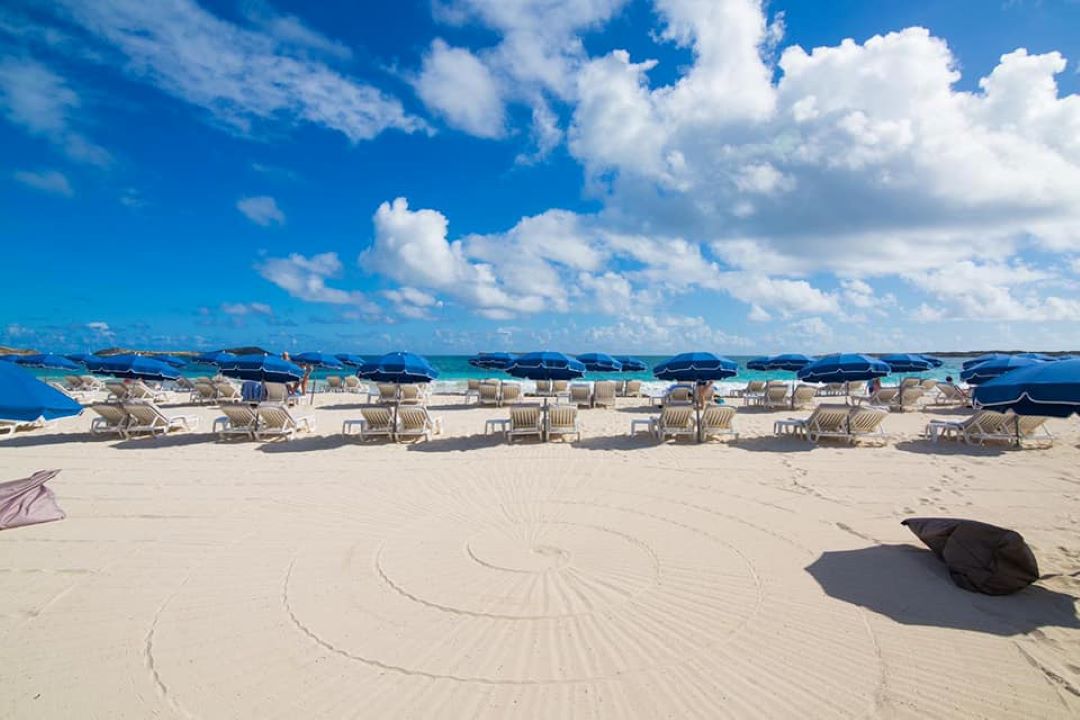
Lombok's beaches occupy a different register from Bali's — quieter, less developed, and backed by more dramatic scenery. The northwest coast, running from Senggigi through Malimbu and Nipah, offers a succession of small coves with clear water and views across the strait to Bali's Gunung Agung on clear mornings. The beach experience here is genuinely unhurried: coconut palms lean over white sand, fishing boats rest on the shore, and the commercial density that characterises Bali's busiest beaches is largely absent. A luxury beach day on Lombok trades on exactly this contrast — the quality of the natural setting without the crowded infrastructure. The water is warm year-round, snorkelling visibility is typically excellent, and the surrounding scenery provides a backdrop that most tropical destinations charge a premium to approximate.
Sasak Culture: Weaving, Pottery and a Living Craft Tradition
The Sasak people, Lombok's indigenous majority, have maintained craft traditions of exceptional refinement across generations. Ikat weaving — in which threads are resist-dyed in complex patterns before being woven on a backstrap loom — is practised in villages across the island, with each community developing its own colour vocabulary and motif language. A piece of quality Sasak ikat requires weeks of preparation for a single metre of fabric; the pattern emerges fully only in the final weaving stage. Pottery villages — Banyumulek, Penujak, and Masbagik — produce unglazed terracotta ware using hand-building techniques largely unchanged for centuries, fired in open pit kilns. Traditional Sasak architecture, with its oval-walled communal halls, survives in a handful of villages designed to manage heat and express collective identity. These crafts are not preserved for visitors — they are the living material culture of a community practising them continuously.
Lombok's Green Interior: Rice Terraces and the Shadow of Rinjani
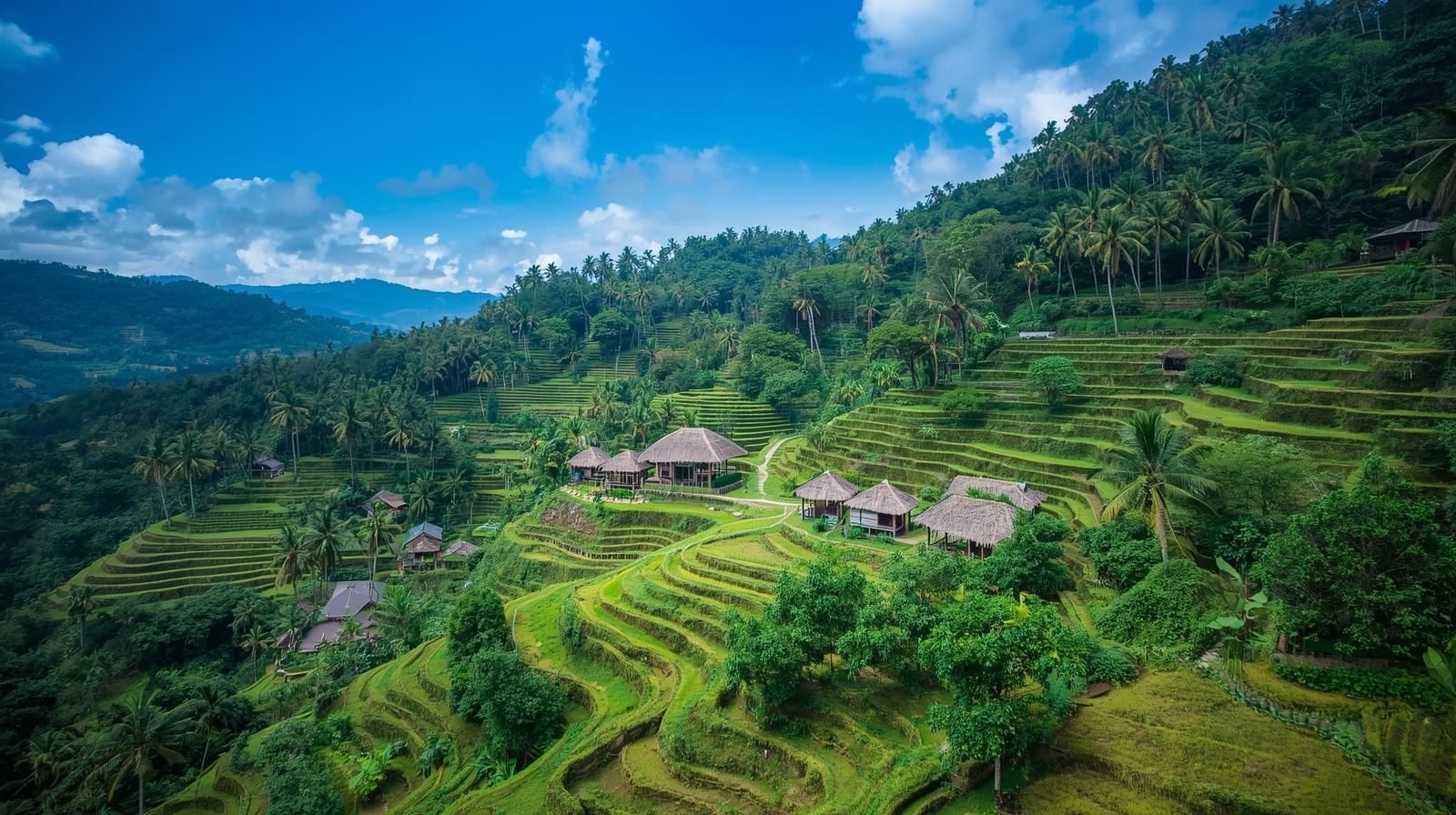
The lowland interior of Lombok — between the coast and Rinjani's lower slopes — is one of the most productive agricultural landscapes in Indonesia: terraced rice paddies in brilliant green, cassava and sweet potato plots, and the cashew and tobacco plantations that form the backbone of the rural economy. The Tetebatu area in the central foothills sits at a cooler elevation where the air carries the smell of wet earth and cloves, and the panoramas north toward Rinjani's summit (3,726 metres) are best on clear early mornings before cloud builds on the caldera. The visual transition from coastal palm-and-sand to highland green is abrupt and striking on any island tour heading north. Gunung Rinjani is sacred to both the Sasak and Balinese communities, its crater lake the site of annual offerings; its presence over the island is felt even when the summit is hidden in cloud.
Lombok Island travel tips
Understanding Lombok's Dual Cultural Heritage. Lombok is not a single culture — it is the meeting point of two. The Sasak people, who form the island's majority, are predominantly Muslim and have their own distinct language, architecture, weaving traditions, and customary law (adat). The Balinese Hindu communities, who settled parts of western Lombok centuries ago, maintain their temples, cremation rites, and festivals alongside their Muslim neighbours in a relationship that is largely peaceful and mutually respectful. Within a short distance you can visit an active Hindu pura (temple), walk through a traditional Sasak village with its distinctive thatched communal halls, and browse a market where both communities trade. Understanding this duality — rather than treating Lombok as a cheaper alternative to Bali — is the key to appreciating what makes the island genuinely distinct and culturally rewarding.
Respect Dress Codes at Religious Sites. Lombok is predominantly Muslim and religious observance is more prominent here than in Bali. Sarongs and shoulder covering are required at mosques and appreciated at traditional villages. Many of the island's most interesting cultural sites — including Sade village and local mosques — will politely turn away visitors in beach clothing. A lightweight sarong takes up negligible bag space and resolves this issue entirely. Photography inside mosques and during prayer times requires explicit permission.
Lombok Coffee is Worth Seeking Out. The highland regions around Tetebatu produce Arabica coffee of genuine quality — complex, slightly fruity, and processed in small lots that rarely make it onto international shelves. Coffee is served at local warungs in the traditional way: grounds in the glass with hot water poured over, allowed to settle before drinking. Buying a small packet of ground coffee directly from producers in the hill villages is a worthwhile souvenir. Kopi tubruk (ground coffee brewed direct in the cup) and kopi susu (coffee with sweetened condensed milk) are the default preparations.
Gili Islands Require Early Action. If the Gilis are your priority, tender off the ship on the first available boat, go directly to Bangsal Harbour (approximately 75–90 minutes from Lembar), and take the first fast boat of the day to Trawangan or Meno. You will have perhaps 3–4 hours on the island before needing to return. Turtle snorkelling at Meno's turtle sanctuary is reliably rewarding in that time. Confirm the last fast boat departure from the island to Bangsal and reverse-calculate your all-aboard time at the ship.
Southern Beaches Are Worth the Drive. The road to Kuta Lombok from Lembar passes through scrubby hills before the southern coast reveals itself in a sequence of bays and cliffs. The drive takes 60–75 minutes but the scenery from Bukit Seger above Kuta is one of the island's better views — peninsula after peninsula extending into turquoise water. Mawun and Selong Belanak beaches, 15–20 minutes further west of Kuta, are calmer for swimming and significantly less visited. If you are going south, go past Kuta rather than stopping there.
Drink Only Bottled or Filtered Water. Tap water in Lombok is not safe to drink. Bottled water (air mineral) is available everywhere and inexpensive. Ice at tourist restaurants is generally made from filtered water; at local warungs, asking for drinks without ice (tanpa es) is prudent. Fresh coconuts (kelapa muda) are an excellent alternative — sold at roadside stalls for a few thousand Rupiah, they are cold, hydrating, and safe.
Port Facts Every Cruiser Needs To Know
Lombok Island shore excursion FAQs
Indonesia offers visa-free entry to citizens of many countries for stays up to 30 days, including most EU countries, the UK, Australia, New Zealand, and several Asian nations. Some nationalities require a Visa on Arrival (available at major entry points including Lembar for cruise ships). Check the current Indonesian immigration rules for your passport before travel, as the visa-free list has expanded in recent years. Your passport must be valid for at least six months from your date of entry.
Most cruise ships anchor in the bay and tender passengers to Lembar Harbour on the island's southwest coast. Lembar is a working cargo and ferry port — facilities for tourists are basic (small cafes, some souvenir sellers, transport touts at the gate). Some itineraries use Teluk Nara or Senggigi as the tender point in the northwest, which dramatically changes your logistics and puts you much closer to the Gili Islands. Check your ship's itinerary details carefully in advance.
Lombok is generally safe for tourists. Petty crime (bag snatching, overcharging on transport) is the primary concern rather than serious crime. The island is quieter and less pressured than Bali, and interactions with locals are typically straightforward and friendly. Areas around Lembar Harbour and some parts of Mataram have the concentration of touts and transport operators that all busy port areas attract — having pre-arranged transport removes most friction. Solo women travellers generally report no serious issues but benefit from the same precautions they would apply anywhere.
Yes, but it requires tight logistics and an early start. From Lembar, you need transport to Bangsal Harbour in the north (approximately 75–90 minutes), then a fast boat to Gili Trawangan or Gili Meno (20–30 minutes). This leaves 3–4 hours on the islands if you depart Lembar at 8am. The Gilis are genuinely worth the effort — crystal-clear water, sea turtles, no motorbikes, beautiful beaches — but the time pressure means you are better off treating it as a dedicated goal rather than combining it with south Lombok destinations.
The Indonesian Rupiah (IDR). As of 2025, USD 1 is approximately IDR 15,500–16,000, meaning amounts in tens and hundreds of thousands are routine. For a port day covering transport, meals, and some shopping, IDR 500,000–800,000 (approximately USD 30–50) is a reasonable cash allowance for one person. ATMs in Mataram and Senggigi are reliable; the area around Lembar Harbour has very limited ATM access. If your ship offers currency exchange, using it before going ashore is practical.
Sasak tenun is a handwoven fabric produced on traditional backstrap looms using cotton thread dyed with natural pigments. The geometric patterns carry specific cultural meanings related to status, occasion, and region of origin. Authentic pieces — distinguished by slightly irregular texture, natural colour variation, and the weight of handspun cotton — take days or weeks to produce. Sade village sells directly from producers; Sukarara village near Puyung is another weaving centre. Prices for authentic pieces are higher than for machine-printed imitations (which are widely sold in tourist markets) — the quality difference is immediately visible to the touch.
Lombok's culinary identity centres on ayam taliwang — a small chicken, typically free-range, grilled or fried and served with a sambal made from red chillies, shrimp paste, tomato, and Lombok's own chilli variety (the Lombok chilli, which gives the island its name in some etymological accounts). Plecing kangkung is a water spinach salad dressed with a sharp, bright sambal that is served with nearly everything. Sate pusut — spiced minced meat formed on lemongrass stalks and grilled — is common at night markets. The food is generally spicier than Javanese or Balinese cooking; if you prefer mild, say kurang pedas (less spicy).
Most of Lombok's southern bay beaches offer good swimming in the calmer sections — Selong Belanak and Mawun are particularly well-suited, with gentle gradient and manageable swell. The Indian Ocean at Kuta Lombok delivers stronger surf at the beach's ends; non-surfers should swim in the middle of the bay where the wave energy is reduced. The Senggigi area on the northwest coast has calmer water, as it faces the Lombok Strait rather than the open Indian Ocean. The Gili Islands have excellent snorkelling conditions with calm, clear water on the sheltered sides of each island.
The differences are significant enough that comparing them is useful mainly to establish that Lombok is not Bali-lite. Lombok is predominantly Muslim (versus Bali's Hindu majority), which shapes daily life, architecture, food, festivals, and the atmosphere in villages. The landscape is more varied — Lombok has a larger active volcano, drier southern plains, and a less-developed interior. Infrastructure is less built-out; tourist services exist but the density that Bali has achieved over decades is absent. This means Lombok rewards visitors who engage with what it actually is rather than arriving expecting a quieter version of somewhere else.
Your ship's all-aboard time and tender cut-off are listed in the daily programme — read them carefully before going ashore. For tender operations, the last tender is typically 30–45 minutes before the ship's departure, and tenders stop running once that deadline passes regardless of who is still ashore. From Kuta Lombok to Lembar Harbour, allow 75–90 minutes in normal conditions. From Senggigi, allow 50–60 minutes. Build an additional 15–20 minute buffer for unexpected traffic or stops. Missing the ship means making your own arrangements to reach the next port at your own expense.
Filters
Select a filter to refine results.
Tour Type
Tour Activity
 Cart
Cart
 USD
USD GBP
GBP AUD
AUD EUR
EUR CAD
CAD