



Tours in Port Of Spain


Cruising to Port Of Spain in a group?
Skip the crowded ship excursion bus. One dedicated planner will design a private shore experience around exactly what your group wants — coordinated from first enquiry to the moment you're back on board. More memorable, more flexible, and more affordable than you might expect. Spend less time organising, more time enjoying.
Explore Group Travel →Cruising to Port Of Spain
Port of Spain occupies a flat coastal plain between the Gulf of Paria and the dramatic Northern Range, and it is — emphatically — a proper working city. Government ministries, oil-company headquarters, and some of the Caribbean's most respected financial institutions set the rhythms here, which means the restaurants, markets, and street-food vendors are calibrated for local taste and local budgets rather than visiting cruise passengers. For the independently minded traveler, this is not a complication. It is the whole point.
Trinidad's population descends from West African enslaved people, indentured laborers from India, freed settlers from North America, British colonial administrators, and waves of Lebanese, Syrian, Chinese, and Venezuelan immigrants — each community leaving an indelible mark on the city's food, music, religion, and architecture. This is the island that gave the world the steelpan, invented in the 1930s from discarded oil drums left by American military installations. It is also the island that hosts the most elaborately costumed street parade on earth each February during Carnival, an event that shapes the national conversation for months before and after its two-day climax.
Queen's Park Savannah — a 260-acre open park at the heart of the city — anchors uptown life and provides a natural compass. The seven Edwardian and Victorian mansions known as the Magnificent Seven line its western edge, their fading grandeur a testament to the colonial sugar wealth that once moved through here. Beyond the Savannah, the Botanical Gardens offer a green retreat, and the National Museum makes a genuinely excellent introduction to the island's layered history. All of this is accessible on foot from the cruise berth, or by a very short taxi ride — making Port of Spain one of the most independently rewarding cities any Caribbean itinerary can deliver.
Top things to do in Port Of Spain on a cruise stopover
The Savannah and the Magnificent Seven: Uptown Port of Spain's Architectural Crown
Queen's Park Savannah is one of the world's largest urban roundabouts — a 260-acre open park functioning simultaneously as jogging track, cricket pitch, informal concert venue, and the city's social lungs. On its western flank stand the Magnificent Seven: seven extraordinary mansions built between 1902 and 1910 by wealthy colonial-era families, each in a wildly different style ranging from Baroque to Moorish to Scottish Baronial. They are in various states of repair — some impeccably maintained, others poignantly faded — but as a group they constitute one of the most architecturally audacious streetscapes in the Caribbean. Walk the perimeter at a leisurely pace and look up; the detail work on the turrets, balconies, and gabled rooflines is extraordinary. A ring of food vendors operates around the Savannah, and the afternoon crowd is reliably lively.
The Art of Doubles: Trinidad's Essential Street Breakfast
Doubles is the unofficial national breakfast of Trinidad: two soft bara flatbreads filled with curried chickpeas (channa), dressed with tamarind chutney, cucumber, shadow beni (a pungent local herb), and — if you're ready for it — the blisteringly hot pepper sauce ladled on to order. It costs the equivalent of about USD 0.50 per piece, is eaten standing at the vendor's cart, and is among the greatest street foods on earth, full stop. The best vendors set up early and sell out by mid-morning; near Independence Square and on the roads around the Savannah you'll find them most mornings before 10am. Order 'slight' pepper if you're unsure; 'plenty' is for the committed. Two or three pieces is the correct first-visit quantity — though veterans rarely stop there.
Trinidad's Story, Told Well: The National Museum and Art Gallery
The National Museum on Frederick Street rewards a deliberate visit rather than a rainy-day fallback. Permanent galleries cover Carnival — with full-scale road march costumes suspended from the ceiling that make the festival's artistic scale immediately comprehensible — as well as the history of steelpan, colonial Trinidad, natural history, and the oil and gas industry that funds the modern nation. The art gallery section displays rotating and permanent collections of Trinidadian and Caribbean fine art, with several genuinely significant works. Admission is free. The Edwardian colonial building itself is worth a few minutes of attention before you go inside. Allow 90 minutes minimum; the Carnival gallery alone can absorb half an hour before you realize how much time has passed.
Steelpan: Following the Sound That Changed Caribbean Music Forever
The steelpan was invented in Trinidad in the late 1930s by hammering the tops of discarded oil drums into tuned percussion instruments — one of the 20th century's most remarkable musical innovations, born out of post-war scrap metal and extraordinary ingenuity. The National Museum covers its origins thoroughly, but the more visceral experience is finding live music. Pan yards — rehearsal venues for steelband orchestras — are scattered across Port of Spain, and during Carnival season the weeks leading up to it their practice sessions are open to visitors and entirely free. Outside of Carnival, ask at the museum or the Visitor Information Centre near the terminal about scheduled performances. The sound of a full steelband in an open yard at dusk is not something that photographs well — it genuinely has to be heard.
Spice and Life: Independence Square and the Central Market
Independence Square — technically a broad double boulevard rather than a square — runs from the cruise terminal west to the Cathedral of the Immaculate Conception and forms the commercial spine of downtown Port of Spain. Vendors sell everything from fresh coconut water to phone cases; roti shops and fabric stores share blocks with pharmacies and money changers. A short walk north, the Central Market on Charlotte Street is a proper working market with vendors selling the spices, tropical fruits, and hot peppers that underpin Trinidadian cooking. Shadow beni, bandanya, dried curry blends — the herbal vocabulary alone is worth the detour. This is where the city's actual daily life unfolds, and it moves at a pace and volume that feels energizing rather than overwhelming.
Over the Mountain and Into the Wild: Maracas Beach
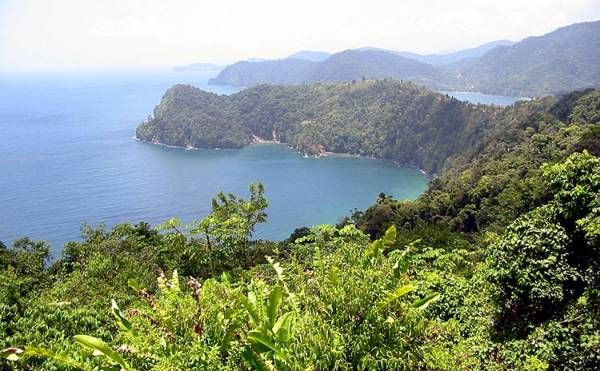
The road to Maracas Beach is itself an experience: it climbs steeply from Port of Spain into the Northern Range, threading through dense forest that parts suddenly to reveal a dramatic bay with dark volcanic sand and heavy Atlantic surf. The drive takes about 45 minutes each way and is best done by hired taxi with a negotiated return fare. Maracas is famous throughout Trinidad for Richard's Bake and Shark — a beachside institution where fried flatbread is split, stuffed with battered shark, and dressed with as many sauces and toppings as you can fit. The beach is beautiful but carries strong surf; swim only between the flags. This is a full half-day commitment, and it suits ships with longer port calls or passengers willing to exchange the city entirely for a different kind of Trinidad experience.
Port Of Spain travel tips
Find Doubles Before 10am — or You'll Miss the Best Ones. The best doubles vendors in Port of Spain operate in the early-to-mid morning and sell out completely by late morning. If your ship arrives early enough, make doubles your first priority — head to Independence Square or the streets around the Savannah and follow the queue of office workers. The vendor with the longest line is invariably the correct choice. Specify 'slight' pepper if you're heat-sensitive; 'no pepper' if you're cautious. Have small TTD bills ready if possible — this speeds the transaction and earns goodwill from a vendor moving at serious pace.
Change Money Before You Hit the Street. US dollars will get you through the day at tourist-facing businesses, but you'll pay a convenience premium and many local vendors simply don't deal in foreign currency. ATMs dispensing TTD are available within a short walk of the cruise terminal on Independence Square and surrounding streets. Withdraw the local equivalent of USD 50–80 to cover street food, taxis, and market shopping — you'll spend it faster than you expect and return to the ship considerably well-fed.
Hire a Taxi Driver as a Day Guide, Not Just a Chauffeur. Trinidadian taxi drivers are among the most knowledgeable informal city guides in the Caribbean. Rather than hailing individual rides throughout the day, find a licensed driver at the cruise terminal and negotiate a half-day rate — typically USD 80–120 for the vehicle — to cover the Savannah, the Magnificent Seven, a market stop, and Maracas Beach if time allows. A good driver will know where to eat doubles, when to avoid the traffic around the Savannah, and which of the Magnificent Seven is worth walking up to for a closer look. Ask for recommendations genuinely and follow them.
The National Museum Is Free and Better Than You're Expecting. It is tempting to treat museum visits as a fallback for bad weather days, but Port of Spain's National Museum deserves a deliberate visit on any day. The Carnival gallery — full-scale road march costumes suspended from the ceiling — communicates the scale and artistry of the festival in a way no photograph manages. The steelpan history display is the most accessible account of the instrument's invention available anywhere. Admission is free. Allow 90 minutes minimum, and pair it with a walk through the Botanical Gardens immediately next door.
Go to Maracas Only If You Have Six Hours or More. Maracas Beach is magnificent, but the road there and back consumes 90 minutes of your port day, the beach deserves at least two hours, and Richard's Bake and Shark demands another 45 minutes minimum. If your all-aboard is tight, skip Maracas and spend the time in the city instead — the food, music, and architecture of Port of Spain are equally rewarding and require no driving over mountain roads. Save Maracas for ships with long port calls or passengers willing to make the beach the entire day's purpose.
Keep Valuables Discreet in the Market Areas. Port of Spain is a lively, functioning capital city rather than a manicured resort, and it deserves to be treated accordingly. The Central Market and Charlotte Street areas are safe and worth visiting during business hours, but this is not the place for a dangling camera strap or a passport in your back pocket. Use a money belt or inner pocket for cards and large bills, carry only what you plan to spend, and stay aware of your surroundings as you would in any busy urban environment. The vast majority of visitors have entirely trouble-free days; straightforward precautions keep it that way.
Port Facts Every Cruiser Needs To Know
Port Of Spain shore excursion FAQs
The Cruise Ship Complex sits on the waterfront, and Independence Square — the commercial heart of downtown — is approximately a 10-minute walk from the gangway. Most of the downtown area, including the Cathedral of the Immaculate Conception, the Brian Lara Promenade, and the Central Market on Charlotte Street, is within a 20-minute walk of the terminal. Queen's Park Savannah and the Magnificent Seven are about 1.5 miles north — a 30-minute walk in the heat, or a USD 5–8 taxi ride. Port of Spain is one of the more walkable Caribbean capitals for cruise visitors.
Port of Spain is safe for daytime independent exploration with the standard common-sense precautions that apply in any city. Stick to the central areas — Independence Square, Frederick Street, the Savannah, and the Botanical Gardens — during daylight hours, keep valuables discreet, and avoid unfamiliar residential neighborhoods. The city has a higher-than-average crime rate by Caribbean standards, but this is concentrated well away from the tourist and commercial center. Thousands of cruise passengers explore independently every season without incident; staying in well-trafficked areas during the day is the fundamental rule.
Doubles is arguably the greatest street food in the Caribbean: two soft bara flatbreads stuffed with curried chickpeas (channa), dressed with tamarind chutney, cucumber, shadow beni (a pungent local herb), and pepper sauce to your specification. It costs roughly TTD 7–10 (about USD 1) and is eaten standing at the vendor's cart. The best vendors operate near Independence Square, on Cipriani Boulevard, and around the Savannah perimeter — arrive before 10am for the best selection. Order 'slight' pepper on your first attempt unless you have a genuine tolerance for serious heat. It is impossible to eat just one.
Yes, but it requires commitment and a realistic port-day timeline. The beach is roughly 45 minutes from the cruise terminal via the scenic North Coast Road, which winds dramatically over the Northern Range. Hire a taxi for the round trip — negotiate a set rate with the driver waiting, typically USD 60–80 for the vehicle — and budget at least two to three hours at the beach. The main draw is Richard's Bake and Shark, a legendary beachside food stall that is itself worth the drive. The beach carries strong Atlantic surf; swim only in designated areas. Total time commitment is 4–5 hours, making it practical for ships with 8-hour or longer port stays.
Trinidad Carnival, held on the Monday and Tuesday before Ash Wednesday, is the Western Hemisphere's most elaborate street festival — hundreds of thousands of participants in extraordinary feathered and beaded costumes, with competing steelbands and soca artists whose music shapes the national conversation for months. Outside of Carnival season, the National Museum's Carnival gallery offers the best introduction anywhere, with full-scale road march costumes on permanent display. Pan yards occasionally offer informal performances or tours throughout the year; the Visitor Information Centre near the cruise terminal can advise on current programming.
Live steelpan is most readily available during Carnival season (January–February), when pan yards hold nightly rehearsals open to the public at no charge. Outside of season, options include scheduled performances at the National Academy for the Performing Arts (NAPA) near the Savannah, informal sessions at some pan yards — ask at the National Museum or the Visitor Information Centre for current programming — and periodic public events in the city center. If nothing is formally scheduled during your visit, the National Museum's audio-visual displays at minimum provide the sound in its historical context.
The list is genuinely long. Bake and shark at Maracas Beach is a pilgrimage for anyone who makes it over the mountain — fried flatbread split and stuffed with battered shark, dressed with a dozen available sauces and toppings. Roti — a soft flatbread wrap filled with curried chicken, goat, or vegetables — is available at roti shops across the city and makes an excellent lunch. Pholourie (fried split-pea fritters with mango chutney) is the ideal street snack. Pelau — rice cooked with pigeon peas and meat in a caramelized coconut base — is the local comfort food. For drinks, try a cold sorrel juice or a fresh coconut from a roadside vendor.
Port of Spain offers more interesting shopping than most Caribbean cruise ports, largely because the market serves residents rather than visitors. The Central Market on Charlotte Street is the destination for spices, locally made pepper sauce, shadow beni seeds, and tropical produce. Frederick Street and Independence Square carry clothing, fabric, and everyday goods. For crafts and artwork, the Cruise Ship Complex has a small artisan market at the terminal; more serious galleries and studios are found uptown near the Savannah. Look for steelpan-related items — miniature instruments, recordings, and pan-inspired jewelry — as distinctly and authentically Trinidadian souvenirs.
Trinidad and Tobago dollars (TTD) are the local currency; the exchange rate is approximately TTD 6.8 to USD 1. Carry a mix of local currency (for street food, markets, and local taxis) and USD (for tourist-facing services). Budget roughly TTD 200–400 (USD 30–60) for a food-focused city day — more if you're hiring a taxi for Maracas or shopping seriously in the market. ATMs near Independence Square dispense TTD at fair rates and are the most practical way to get local currency. Credit cards are accepted at restaurants and shops in the tourist center but rarely at street vendors or market stalls.
Port of Spain is one of the most independently manageable cruise ports in the Caribbean. The city center is walkable from the gangway, English is the official language, and the main attractions require no advance booking — the National Museum is free, the Savannah is a public park, and street food vendors don't take reservations. For Maracas Beach, negotiating a taxi fare at the terminal is entirely straightforward. The primary argument for a cruise-line excursion is the guarantee that the ship waits if your group is delayed — a real consideration for the Maracas beach trip, where mountain road traffic can occasionally slow the return journey.
Filters
Select a filter to refine results.
Tour Type
Tour Activity
 Cart
Cart
 USD
USD GBP
GBP AUD
AUD EUR
EUR CAD
CAD