



Tours in Aqaba


Cruising to Aqaba in a group?
Skip the crowded ship excursion bus. One dedicated planner will design a private shore experience around exactly what your group wants — coordinated from first enquiry to the moment you're back on board. More memorable, more flexible, and more affordable than you might expect. Spend less time organising, more time enjoying.
Explore Group Travel →Cruising to Aqaba
Aqaba is Jordan's sole coastline city, sitting at the northern tip of the Red Sea where Jordan, Israel, Saudi Arabia and Egypt meet across narrow stretches of water. As a cruise port, its primary significance is as the closest access point to Petra — the Nabataean rock city 120km to the north — and to Wadi Rum, the desert wilderness that has defined imagery of the Arabian peninsula for centuries. The port area itself is compact and navigable, with a restored Ottoman fort, a waterfront promenade and a local souk offering an hour or two of exploration for those who remain in the city. But for most visitors, Aqaba is a starting point rather than the destination. The two principal excursions diverge sharply in character: Petra demands time, walking and sustained attention; Wadi Rum rewards stillness and an appetite for open space. Both require significant road travel, which shapes the rhythm of any day spent ashore here.
Top things to do in Aqaba on a cruise stopover
The Treasury at Petra (Al-Khazneh)
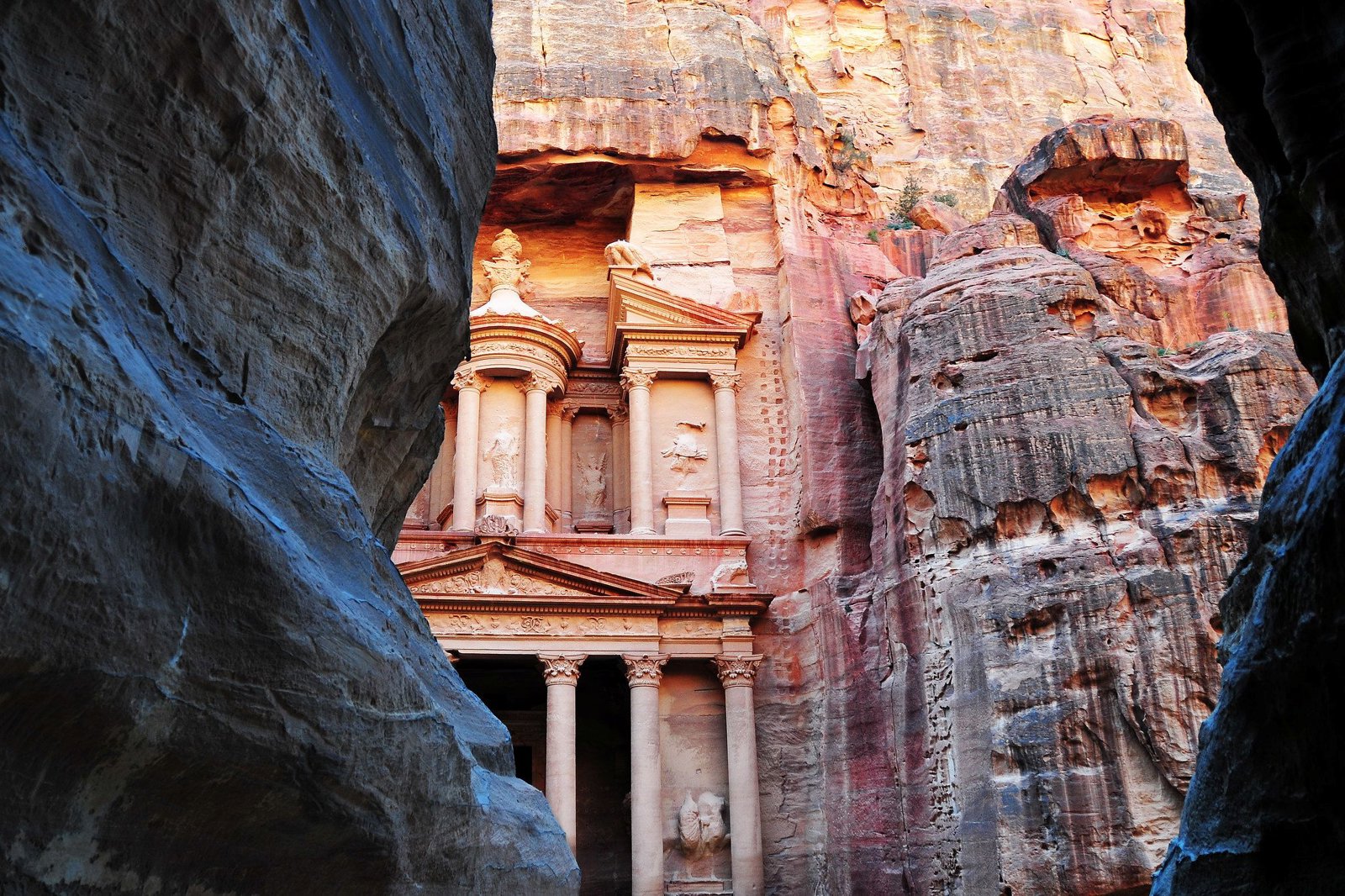
The defining image of Petra, the Treasury's elaborate facade rises 40 metres from the canyon wall at the end of the Siq. Carved directly into rose-red sandstone by Nabataean craftsmen in the first century BC, it served likely as a royal tomb. Despite its name — given by Bedouin who believed its upper urn concealed pharaonic treasure — the interior is a single unadorned chamber. Standing before it after the walk through the Siq is one of those genuinely affecting travel experiences that photographs fail to fully prepare visitors for.
The Siq: Petra's One-Kilometre Canyon Entrance
The approach to Petra's heart runs through the Siq, a narrow gorge between towering sandstone cliffs that soar up to 200 metres. The path follows an ancient Nabataean water channel and occasionally widens to reveal carved niches, gods' blocks and remnants of a Roman road. Light plays differently at each hour along the rock walls' swirling layers of pink, orange and cream. The reveal of the Treasury facade at the canyon's end is one of the great theatrical moments in travel — gradual, then sudden.
Petra's Monastery (Ad Deir): The Hidden Giant
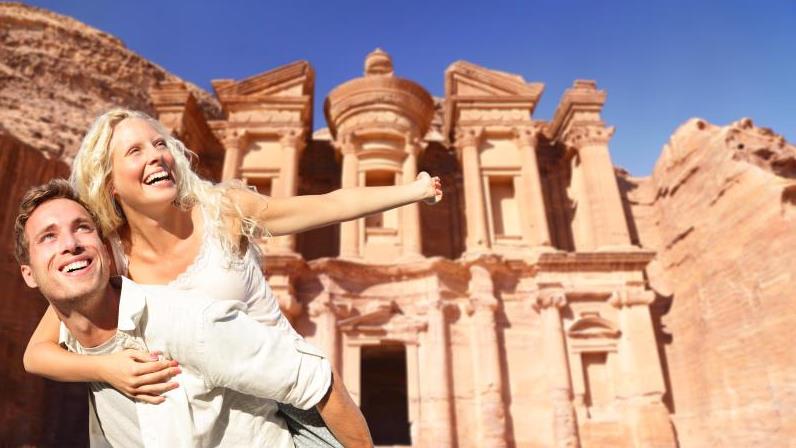
Reached by approximately 800 rock-cut steps, the Monastery is larger than the Treasury — 47 metres wide and 48 metres tall — but far less visited, offering a more solitary encounter with Nabataean craftsmanship. The climb takes around 40 minutes and the effort is considerable, but from the ridge above, views extend across Wadi Araba towards Israel. The Monastery rewards those with time and energy beyond the main Petra basin.
Wadi Rum: A Desert Shaped by Ancient Forces
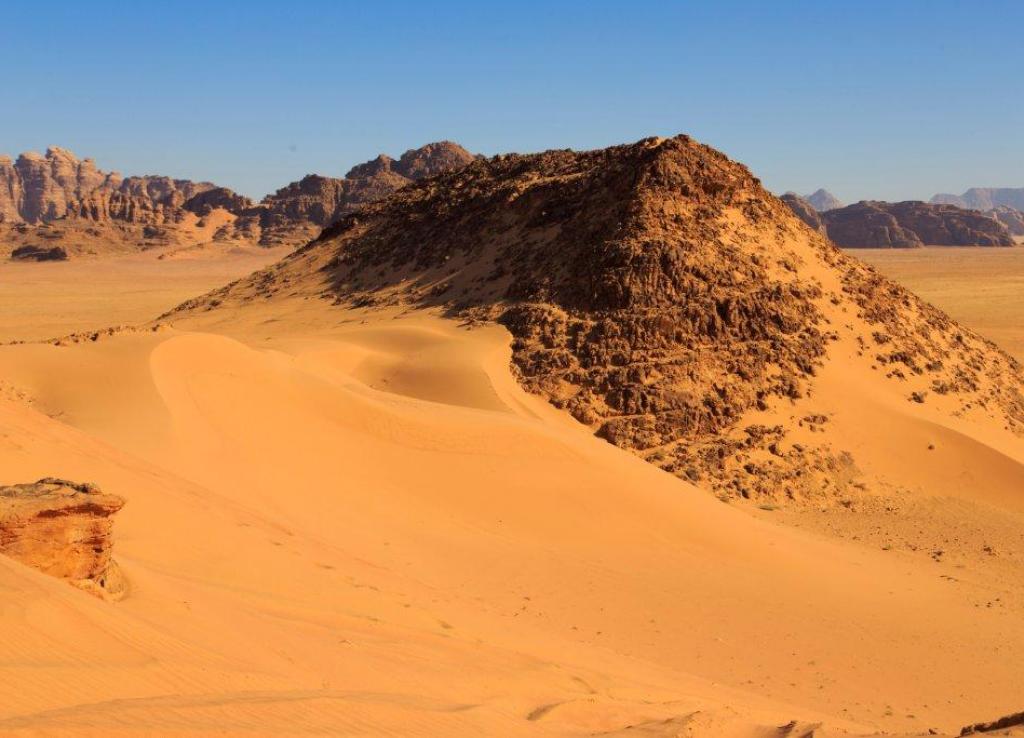
Jordan's most spectacular desert landscape stretches across 720 square kilometres of sandstone mountains, rock arches, dunes and narrow gorges in shades of red, ochre and amber. The area has been inhabited since prehistoric times — rock inscriptions and petroglyphs document Nabataean, Thamudic and early Islamic presence. Wadi Rum appeared in the writings of T.E. Lawrence and continues to draw visitors for its extraordinary silence and scale, which no image fully conveys.
Wadi Rum Jeep Safari: Reading the Desert at Ground Level
Traversing Wadi Rum by 4x4 opens access to the landscape's remoter features — Lawrence's Spring, vast sand dunes, natural sandstone bridges and narrow siq canyons that split the rock formations. Routes are guided by Bedouin drivers with deep local knowledge of the terrain. The quality of light in late afternoon turns the desert extraordinary shades of copper and rose, making the experience as visually compelling as it is spatially immersive.
Aqaba's Red Sea Waterfront and Historic Fort
Aqaba Fort, built by the Crusaders and later held by Mamluk and Ottoman rulers, stands near the waterfront as evidence of the port's strategic importance along ancient trade routes. The adjacent waterfront promenade connects to café areas and the local souk. The Red Sea here is warm and clear, with coral reef formations close to shore supporting rich marine life visible to snorkellers.
Aqaba travel tips
Start Early for Petra. The site opens at 6am and the Siq canyon light is exceptional in the early morning hours. Arriving before the main wave of group visitors reduces crowding at the Treasury significantly. Allow at least 4–5 hours to walk beyond the Treasury into Petra's wider basin of temples, tombs and colonnaded streets. The site is considerably larger than most visitors anticipate.
Dress Appropriately for Both Sites. Both Petra and Wadi Rum are in culturally conservative areas. Women should carry a lightweight scarf and wear clothing covering shoulders and knees. This is equally practical for sun protection during extended walks through exposed rock and desert terrain. Comfortable shoes with ankle support are essential at Petra — the terrain is uneven compacted earth and rock over several kilometres.
Jordan Pass Covers Petra Entrance Fees. The Jordan Pass, available online before travel, includes Petra entry fees and Jordan visa costs in one purchase. Petra's standalone entry fee without the Pass is substantial, so this is worth checking before the cruise if a Petra visit is planned. The Pass also covers entry to many other Jordanian sites if travel extends beyond the cruise call.
Petra Is Far Larger Than It Appears on Images. The Treasury is just the beginning. The site extends several kilometres beyond, encompassing the colonnaded street, royal tombs, the Temple of the Winged Lions and the distant Monastery. Visitors who see only the Treasury and return miss the full depth of the site. Allocating enough time to walk the main basin is the single most important planning decision for a Petra visit.
Consider the Order of Wadi Rum and Petra. If visiting both sites in a single day, the sequence matters. Late afternoon light in Wadi Rum is exceptional — the desert turns deep copper tones as the sun drops. Some visitors prefer to do Petra first (earlier in the day when energy is highest for walking) and Wadi Rum on the return journey. Others reverse this depending on transport arrangements.
Currency and Tipping Customs in Jordan. The Jordanian Dinar is the local currency; US dollars are widely accepted at tourist sites and major restaurants. Tipping is customary — around 10% at restaurants, and small gratuities are appreciated by site guides and Bedouin hosts. Carrying a range of smaller-denomination notes is useful, as change at small vendors can be limited.
Port Facts Every Cruiser Needs To Know
Aqaba shore excursion FAQs
Petra is approximately 120km north of Aqaba by road, a journey of around 2 to 2.5 hours each way depending on conditions. The return drive plus time at the site makes for a full day's commitment. Allow at least 3–4 hours at Petra to see the main highlights without feeling rushed.
It is possible but demanding. Wadi Rum lies approximately 60km from Aqaba and 80km from Petra, making a logical loop feasible in principle. In practice, spending meaningful time at both within a single cruise day leaves limited margin at each. Choosing one destination and visiting it properly is often a more satisfying approach.
Yes — Aqaba's waterfront promenade, the historic fort, and the local souk offer a pleasant 2–3 hours for visitors who prefer to remain in port. The town is compact and generally walkable with a relaxed atmosphere. The Red Sea waterfront is also accessible for those interested in the coastline.
Comfortable walking shoes with ankle support are important — the terrain involves uneven rock and compacted earth over several kilometres. Light, breathable clothing that covers shoulders and knees is both culturally appropriate and practical. A hat, sunscreen and plenty of water are essential, particularly in spring and autumn when the site can be surprisingly warm.
Yes — jeep safari tours make Wadi Rum accessible to those who prefer not to walk, as 4x4 vehicles traverse the main landscape features including dunes, rock arches and canyon passages. Walking excursions within the desert vary in difficulty. The terrain in the main areas is generally flat, though some optional routes involve scrambling.
The Jordanian Dinar (JOD) is the official currency, divided into 1,000 fils. US dollars are accepted at most tourist sites, large hotels and many restaurants. ATMs are available in central Aqaba for withdrawing Jordanian Dinars. Credit cards are accepted at major attractions and hotels, though smaller vendors may prefer cash.
Yes — Petra has a visitor centre at the entrance with toilets, and facilities are available at intervals throughout the site. The main basin has several café and restaurant options near the colonnaded street. Basic refreshment stops also exist along the Monastery trail. Water should still be carried, as distances between facilities can be significant.
Petra's main entrance opens at 6am year-round. Closing time varies seasonally — typically around 6pm in summer and 4–5pm in winter. Given the 2–2.5 hour drive from Aqaba, reaching the site at opening requires departing the port very early, which can be logistically challenging but significantly improves the experience at the Treasury.
Wadi Rum contains numerous ancient rock inscriptions and Nabataean petroglyphs, a small Bedouin village, and the Seven Pillars of Wisdom rock formation referenced in T.E. Lawrence's writings. The Rum Fort near the visitor centre dates to the Arab Revolt period. The area is also noted for its exceptional night sky clarity, though this is beyond the scope of a daytime cruise visit.
Aqaba Fort, built in the 14th century by the Mamluk sultan, is the town's most significant historical monument. The waterfront promenade runs along the Red Sea coastline and connects to café and restaurant areas. The local souk offers spices, textiles and regional crafts. Coral reef formations close to shore support snorkelling for those who bring or rent equipment.
Filters
Select a filter to refine results.
Tour Type
Tour Activity
 Cart
Cart
 USD
USD GBP
GBP AUD
AUD EUR
EUR CAD
CAD