



Tours in Argostoli


Cruising to Argostoli in a group?
Skip the crowded ship excursion bus. One dedicated planner will design a private shore experience around exactly what your group wants — coordinated from first enquiry to the moment you're back on board. More memorable, more flexible, and more affordable than you might expect. Spend less time organising, more time enjoying.
Explore Group Travel →Cruising to Argostoli
Argostoli is the capital and main port of Kefalonia, the largest of the Ionian Islands and one of Greece's most dramatically varied. The town that greets arriving cruise ships is almost entirely a post-1953 reconstruction — the catastrophic August earthquake of that year destroyed nearly every building on the island, and Argostoli was rebuilt systematically in a style that echoes its Venetian predecessor without replicating it. The result is a functional, pleasant town with a lively harbour, a good pedestrian street and a waterfront promenade overlooked by cafés and tavernas. The real appeal of Kefalonia lies beyond the town: the underground lake at Melissani, where light pours through a collapsed roof onto impossibly coloured water; the vast stalactite chamber of Drogarati Cave; the clifftop panorama over Myrtos Beach; and Fiskardo, the one village that survived the earthquake intact. The island rewards those who venture away from the port, and a cruise call here offers a genuine window into Ionian landscape and character.
Top things to do in Argostoli on a cruise stopover
Melissani Lake: Light Through a Collapsed Ceiling
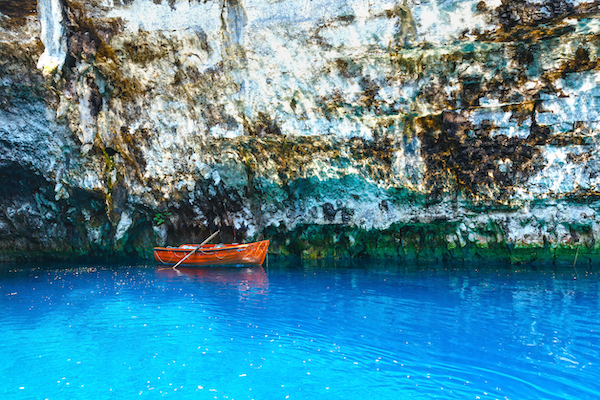
Melissani is an underground lake inside a partially collapsed cave, where daylight pours through a roof aperture and reflects off water ranging from turquoise to deep indigo. Rowing boats carry visitors through the cave's two chambers — one fully enclosed in near-darkness, the other open to the sky. The play of refracted light changes throughout the day, with late morning producing the most vivid colour contrast. The cave system connects through underground channels to the sea at Argostoli, a journey first traced by geologists using dye in the 1960s — confirming what local Kefalonians had long believed.
Drogarati Cave: A Cathedral of Stalactites
Three kilometres from Sami, Drogarati is one of the largest and most accessible caves in Greece, opened to visitors after an earthquake in the 18th century revealed its entrance. A staircase leads to a vaulted chamber approximately 65 metres across, hung with stalactites and stalagmites formed over an estimated 150 million years. The cave's acoustics are exceptional — concerts have been performed here, including a notable recital by Maria Callas. The interior maintains a constant temperature of around 18°C regardless of season outside.
Myrtos Beach: Kefalonia's Clifftop Panorama
Approached by a road that winds down from a panoramic clifftop viewpoint, Myrtos is consistently ranked among the most visually striking beaches in Greece. The beach is a crescent of white limestone pebbles backed by sheer grey-white cliffs and washed by water of an intensely vivid turquoise. The viewpoint above — accessible even without descending to the beach — offers one of the Ionian's most photographed seascapes. Swimming conditions here are excellent when seas are calm.
Argostoli Town and the Drapano Bridge
Argostoli was rebuilt after the 1953 earthquake in a style that preserved elements of its Venetian character. The Lithostroto pedestrian street, Vallianos Square and the harbour waterfront form the town's lively core. The Drapano Bridge — a causeway built by the British in 1813 — crosses the lagoon and is a distinctive local landmark. The town's archaeological museum holds Mycenaean artefacts from the island's ancient past. The lagoon around the bridge is one of the few places in Greece where loggerhead sea turtles are regularly observed from shore.
Fiskardo: The Village the Earthquake Spared
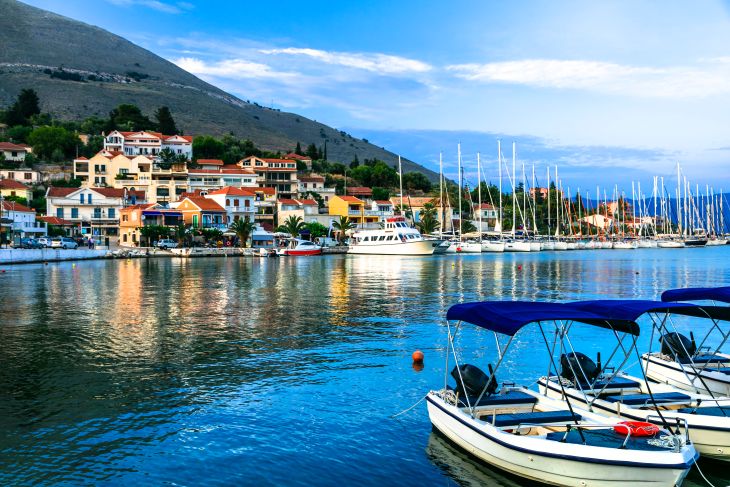
Fiskardo is the only Kefalonian village that survived the 1953 earthquake largely intact, preserving its traditional Venetian-influenced architecture — painted facades, shuttered windows, geranium-filled balconies and a picturesque harbour. The village sits at the island's northern tip and has a distinctly unhurried character compared to more visited areas. A small archaeological site and Byzantine lighthouse ruins are within easy walking distance. For those with enough time, it offers the most tangible connection to Kefalonia's pre-earthquake appearance.
Kefalonia's Natural Wonders and Island Interior
Away from the coast, Kefalonia rises toward Mount Ainos, a national park cloaked in endemic Abies cephalonica black fir — a tree species found nowhere else in the world. The island's interior villages and the Monastery of Saint Gerasimos, dedicated to Kefalonia's patron saint, offer a quieter counterpoint to the coastal highlights. Kefalonia's geological diversity — porous limestone karst, underground rivers, caves and springs — gives the island a natural richness that goes well beyond its beaches.
Argostoli travel tips
Time Melissani for Late Morning Light. The light effect inside Melissani Cave is most dramatic around 11am–1pm when sunlight falls directly through the roof aperture, creating the most vivid colour contrast in the water. Earlier visits produce more muted light. Boat tours inside the cave take approximately 20–25 minutes, so the site does not require a lengthy visit — but timing it well significantly enhances the visual impact.
Combine Melissani and Drogarati on the Same Trip. The two cave attractions near Sami are approximately 3km apart and pair naturally as a half-day excursion. Drogarati requires about 30–40 minutes; Melissani, including the boat ride, around 20–25 minutes. Together with travel from Argostoli and a stop for lunch in Sami, the combination makes for a well-structured and satisfying day without over-committing on distance.
Watch for Loggerhead Turtles in the Lagoon. The lagoon around Argostoli is one of the rare places in Greece where loggerhead sea turtles (Caretta caretta) are routinely visible from shore. Fishermen returning to the quayside in the morning often have turtles following in their wake, and the animals are frequently spotted from the Drapano Bridge. No special arrangement is needed — it is simply part of the town's daily life, most reliably observed in the morning hours.
Allow Extra Time for Mountain Roads. Kefalonia's roads are winding, often single-lane in mountain sections, and journey times are consistently longer than distances suggest. The road to Myrtos Beach and the northern route toward Fiskardo both involve hairpin bends on clifftop roads with limited passing places. Allow more travel time than a map calculation indicates, and note that parking at popular viewpoints fills quickly during summer months.
Seek Out Robola Wine. Kefalonia's Robola grape produces a dry, crisp white wine with floral notes that is distinctive and rarely available outside the island. The Robola Cooperative in the Omala valley, close to the monastery, is a short drive from Argostoli. Bottles are available at local shops, tavernas and the cooperative's own outlet. It makes a worthwhile discovery for those with any interest in regional wine.
The 1953 Earthquake Shapes Everything You See. Almost every building in Argostoli and most Kefalonian villages dates from after the catastrophic August 1953 earthquake, which destroyed nearly all structures on the island. Understanding this context transforms the rebuilt town — Argostoli was reconstructed rapidly in a traditional style as an act of collective cultural recovery. The few pre-earthquake buildings that survive, particularly in Fiskardo, carry considerably different historical weight as a result.
Port Facts Every Cruiser Needs To Know
Argostoli shore excursion FAQs
Yes — the waterfront promenade, Lithostroto pedestrian street, Vallianos Square and the Drapano Bridge causeway all lie within easy walking distance of the quay. The Archaeological Museum and a selection of good cafés and tavernas make the town a pleasant base for 1–2 hours of exploration without needing to venture further into the island.
Melissani Cave is approximately 30km from Argostoli, near the town of Sami on the island's eastern coast. The drive takes around 35–45 minutes on winding mountain roads. Boat tours inside the cave last approximately 20–25 minutes, and the site can be combined with Drogarati Cave nearby.
Yes — the two cave sites are approximately 3km apart, both near Sami. Most visitors combine them on the same outing, spending 30–40 minutes at Drogarati and 20–25 minutes at Melissani. Together with travel time from Argostoli and a stop for lunch in Sami, allow approximately 3.5–4 hours total.
Myrtos Beach, roughly 35km north, is widely considered Kefalonia's most spectacular. Its white limestone pebbles, sheer cliffs and vivid turquoise water are genuinely striking. The clifftop viewpoint above the beach is equally impressive and accessible without descending. Swimming conditions are excellent when seas are calm, though the beach is exposed to swells on windier days.
Fiskardo is beautiful and architecturally unique as Kefalonia's only largely intact pre-earthquake village. However, it is approximately 50km north of Argostoli on winding roads — around 70–80 minutes each way. Fitting it into a cruise day alongside Melissani or Drogarati is challenging, but possible for those with an early disembarkation time and efficient planning.
A series of major earthquakes in August 1953 devastated Kefalonia and the surrounding Ionian island chain. The island suffered near-total destruction of its towns and villages. Fiskardo in the north was one of the very few settlements to survive largely intact. The extensive reconstruction that followed produced Argostoli's current townscape, almost entirely built from the mid-1950s onward.
Yes — the harbour waterfront has several well-regarded tavernas serving fresh fish and seafood. The quayside fish market area is a reliable stretch for lunch or early evening meals. Local dishes include grilled sea bream, red mullet and octopus. Kefalonian meat pie (kreatopita) is also widely available and worth trying as a locally distinctive dish.
Late morning, around 11am to 1pm, is when direct sunlight enters through the cave's roof opening and creates the most vivid colour in the water — ranging from turquoise to deep blue depending on depth. Earlier visits produce more muted, diffuse light. Photography is generally permitted inside the cave, though the low-light environment benefits from a camera capable of reasonable performance at higher ISO settings.
Both caves are typically open daily from approximately 9am to 7pm or 8pm in summer, with reduced hours in shoulder and off-season periods. Hours can vary and are subject to change, so it is worth confirming current times before the visit. Argostoli's Archaeological Museum generally opens around 8:30am and closes by 3:30pm, though this also varies seasonally.
Argostoli town centre is relatively flat and accessible from the port. Melissani Cave involves a moderate staircase descent and stepping into a rowing boat, which may present challenges. Drogarati Cave's main chamber is reached by a flight of steps. Myrtos Beach is pebbled and accessed via a steep descent road. The island's mountain roads and most historic sites involve uneven terrain that can be demanding for those with significant mobility limitations.
Filters
Select a filter to refine results.
Tour Type
Tour Activity
 Cart
Cart
 USD
USD GBP
GBP AUD
AUD EUR
EUR CAD
CAD