



Tours in Brindisi


Cruising to Brindisi in a group?
Skip the crowded ship excursion bus. One dedicated planner will design a private shore experience around exactly what your group wants — coordinated from first enquiry to the moment you're back on board. More memorable, more flexible, and more affordable than you might expect. Spend less time organising, more time enjoying.
Explore Group Travel →Cruising to Brindisi
Brindisi has been one of the Mediterranean's most strategically significant ports for over two millennia. This was where the Appian Way — ancient Rome's greatest road — reached its terminus, where Crusader fleets assembled, and where generations of travellers have crossed the Adriatic toward Greece and the East. Today the city retains its ancient Roman column near the harbour, a Norman cathedral, and an Aragonese castle, but for most cruise passengers Brindisi serves primarily as the gateway to Puglia's extraordinary interior. The region around Brindisi encompasses olive groves and dry-stone walls stretching to the horizon, the baroque hill town of Ostuni, and — most famously — Alberobello, whose dense cluster of trulli (conical dry-stone hut-dwellings) earned UNESCO World Heritage status in 1996. Pugliese food, one of Italy's most celebrated regional cuisines, is reason enough to spend time at table.
Top things to do in Brindisi on a cruise stopover
Alberobello and the UNESCO Trulli Zone
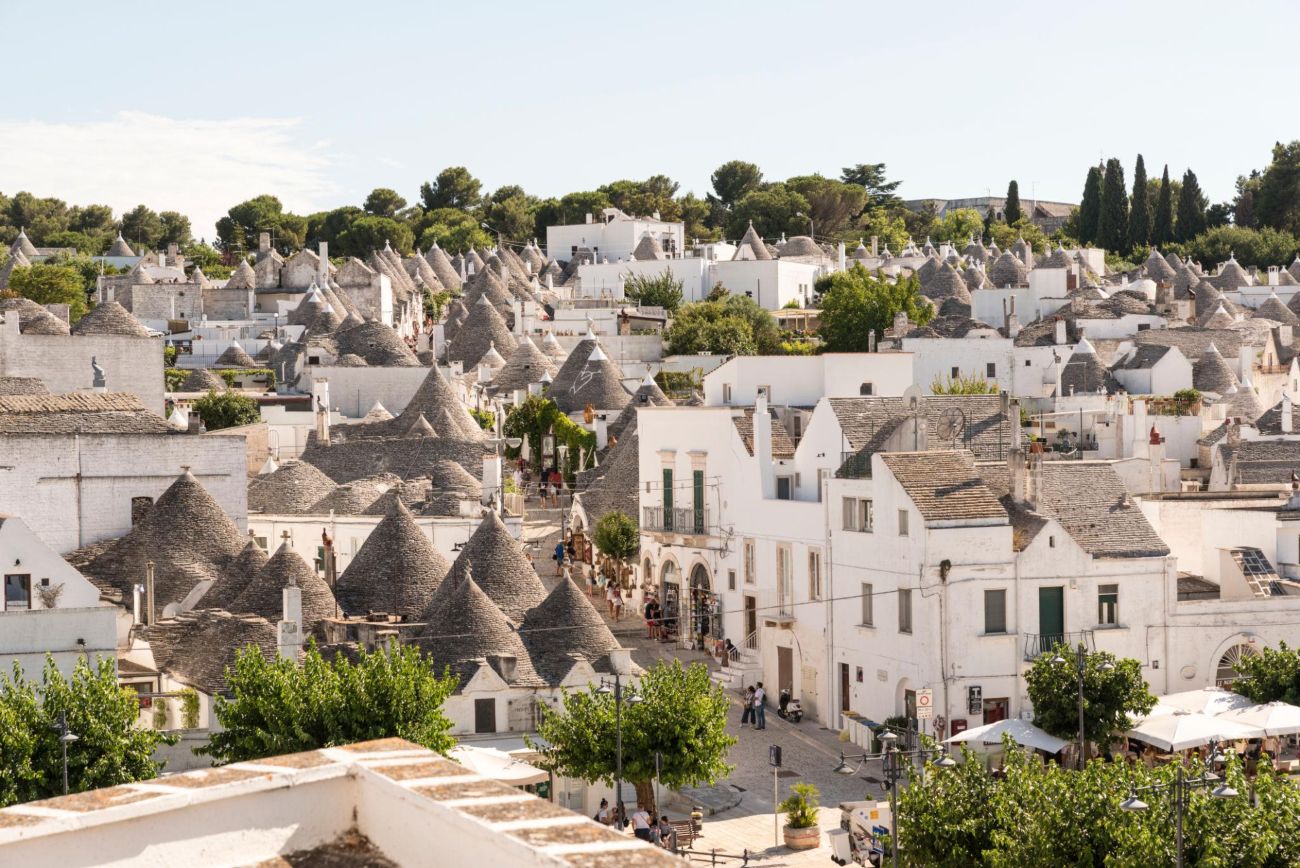
Alberobello's Rione Monti neighbourhood is among the most visually distinctive townscapes in Italy. Over 1,500 trulli — dry-stone round dwellings with conical limestone roofs, whitewashed walls, and ancient symbols painted on the pinnacles — crowd the hillside in a settlement unlike anything else in Europe. The trulli tradition dates back several centuries, linked to local feudal customs. UNESCO listed the town in 1996. Arriving early in the morning before tour coaches crowd the main lanes rewards visitors with far better atmosphere and photography opportunities. The upper lanes of Rione Monti, away from the souvenir shops, preserve the most authentic character.
Inside the Trulli: Trullo Sovrano and Living History
Trullo Sovrano — Alberobello's only two-storey trullo — operates as a small museum and offers insight into the interior organisation of these unusual dwellings. Most trulli were divided into functional spaces: sleeping, cooking, storage, all within the cone-roofed chambers. The interiors are cool even in summer, owing to the thermal mass of the limestone construction. Several trulli along the main lanes have been converted into restaurants, shops, and accommodation, allowing visitors to appreciate the spaces as living structures rather than ruins.
Brindisi's Roman Column and the End of the Appian Way
At the harbour's edge in Brindisi stands the surviving terminal column of the Via Appia — the great Roman road that ran 560 km from Rome's Porta Capena to this point on the Adriatic. The column (a second one fell in 1528) has marked the port entrance since ancient times and stands as one of the most evocative ancient monuments in Puglia. The area around the column contains further Roman and medieval remains, and the short walk up from the port takes visitors through the heart of Brindisi's old town.
Brindisi's Norman and Medieval Heritage
The Cathedral of Brindisi — largely rebuilt after an 18th-century earthquake — incorporates Norman elements and stands on the site of an earlier Roman structure. The Aragonese castle overlooking the inner harbour was built in the 16th century and remains one of the city's defining landmarks. The Archaeological Museum Francesco Ribezzo in the town centre holds Roman bronzes, medieval artefacts, and a collection documenting the region's ancient past from Bronze Age settlements through the Roman imperial period.
Puglia's Olive Groves and Dry-Stone Landscape
The drive or train journey between Brindisi and Alberobello passes through one of the most characteristic agricultural landscapes in Italy. The Murgia plateau is covered in ancient olive groves — some individual trees are over a thousand years old — interspersed with dry-stone walls (muretti a secco), masserie (fortified farmhouses), and occasional trulli scattered across the countryside. Puglia produces approximately 40% of Italy's olive oil. The landscape itself is as much a part of the regional experience as the monuments.
Orecchiette and Pugliese Table Culture
Puglia's culinary identity is exceptionally strong. Orecchiette — small ear-shaped pasta made daily by hand — is the signature dish, most traditionally served with cime di rapa (bitter broccoli-like greens) sauteed with garlic, anchovies, and olive oil. In the lanes of Bari, 70 km north, women still make orecchiette on their doorsteps; in Brindisi and Alberobello, local restaurants serve the same tradition. Burrata, invented in the nearby town of Andria, appears on almost every menu — it should be eaten as fresh as possible, ideally at room temperature.
Brindisi travel tips
Go Early to Alberobello — Coaches Arrive by Mid-Morning. Alberobello is one of the most-visited sites in Puglia and cruise passengers are far from alone in making the journey. Large coach groups typically arrive from 10am onward. Those who reach the trulli zone by 9–9:30am find much quieter lanes, better light for photography, and a more genuinely atmospheric experience. The difference between early morning and late morning in the main trullo district is very significant.
The Upper Lanes of Rione Monti Are More Rewarding Than the Lower Shops. The lower part of Rione Monti nearest the main entrance is densely lined with souvenir shops selling trullo-shaped ceramics and tourist goods. The upper and side lanes of the same neighbourhood — still within the UNESCO zone — are quieter, more residential in character, and offer far better views and atmosphere. Spending most of your time in those upper lanes rather than the commercial strip makes for a much more rewarding visit.
Try Burrata and Orecchiette at a Sit-Down Restaurant. Puglia's food culture rewards sitting down for a proper meal rather than eating on the move. A lunch of burrata followed by orecchiette alle cime di rapa at a local restaurant in Alberobello or Brindisi represents exceptional value compared to equivalent quality elsewhere in Italy. Many restaurants in both towns offer a fixed-price lunch menu (pranzo fisso) that includes multiple courses with wine at modest cost.
The Train to Alberobello Requires a Change and Takes Planning. The independent rail option from Brindisi to Alberobello involves a change at Taranto and takes approximately 2 hours each way on FSE regional trains. This is feasible but requires precise timing against your ship's schedule. Check current FSE timetables (Ferrovie del Sud Est) before relying on this option — services can be infrequent on certain days. The journey through Puglia's interior is scenic and the train an enjoyable way to travel if time allows.
Dress Lightly and Wear Comfortable Shoes for Cobblestones. Alberobello's trulli district is built on a hillside with uneven cobblestone streets and stepped lanes that are genuinely challenging in anything but flat, comfortable footwear. The lanes can be slippery when wet. In summer, lightweight breathable clothing is essential — the trulli offer shade but the streets between them are exposed. Carry water, as facilities within the trulli zone can be limited.
Don't Skip Brindisi Town if Time Is Short. If your schedule doesn't allow a full excursion to Alberobello, Brindisi's own historic centre offers a genuinely interesting 2-hour walk: the Appian Way column at the harbour, the Aragonese castle, the cathedral, and the Archaeological Museum. The waterfront Corso Garibaldi and the old town are pleasant for strolling. Brindisi has a distinctive end-of-the-road character as the Adriatic terminus of ancient Rome's greatest highway — it rewards a slow walk.
Port Facts Every Cruiser Needs To Know
Brindisi shore excursion FAQs
Alberobello is approximately 55 km northwest of Brindisi by road, typically 50–70 minutes by car or coach depending on traffic and route. By train, the journey requires a change at Taranto and takes around 2 hours each way. The distance makes pre-arranged transport the most practical option for cruise passengers with limited time.
Yes, for most visitors it is a highlight of any Puglia cruise. The UNESCO trulli zone is genuinely unlike anywhere else in Europe — visually distinctive, historically interesting, and compact enough to cover thoroughly in 90 minutes to 2 hours within the town itself. The main challenge is the travel time from Brindisi, which requires efficient timing.
Yes. The main Brindisi cruise terminal is in the inner harbour, approximately 10–15 minutes on foot from the Appian Way column and the old town centre. The Costa Morena outer terminal is further from the centre and usually served by a shuttle. Confirm which terminal your ship is using before planning to walk.
The trulli of Alberobello were listed by UNESCO in 1996 as a World Heritage Site. Trulli are conical dry-stone dwellings with whitewashed walls and pointed limestone roofs, built using a distinctive local construction technique without mortar. The Rione Monti neighbourhood contains over 1,500 of them and represents the largest concentration of this building type in the world.
Puglia is one of Italy's most celebrated food regions. The essential dishes are orecchiette pasta (especially with cime di rapa), burrata cheese (ideally fresh), friselle (hard bread rings soaked in water and olive oil), taralli biscuits, and fave e cicoria. Local olive oil is outstanding. The wines — Primitivo, Negroamaro, and Verdeca — are full-bodied and excellent value. Most restaurants in both Brindisi and Alberobello offer very good quality at modest prices.
Alberobello is a well-established international tourist destination and English is spoken at most of the trulli-zone businesses, restaurants, and visitor facilities. Outside the main tourist areas, Italian is needed. In Brindisi city, English is less consistently spoken, though staff in the port area, larger restaurants, and at key monuments generally manage basic communication.
The Brindisi region offers several notable destinations within cruise day-trip range. Ostuni — the 'White City' — is a striking hilltop baroque town approximately 35 km north. Lecce, 35 km south, is famous for elaborate baroque architecture in golden limestone, sometimes called the 'Florence of the South.' The coastal towns of Fasano and Monopoli are also within range. Most of these require private transport given typical ship schedule constraints.
Early morning — arriving by 9–9:30am — is significantly better than later in the day. Large coach groups typically arrive from around 10am onward, and by late morning the main lanes of Rione Monti can be very crowded. Early arrivals experience quieter streets, better light for photography, and a more atmospheric visit. The town itself opens up at around 8am.
The UNESCO trulli neighbourhood itself — walking the streets and lanes of Rione Monti — is free to visit. Individual trullo-museums (including Trullo Sovrano) charge a small entrance fee, typically €1.50–€3. Some trulli are operated as shops, restaurants, or accommodation and are accessible without charge. The open-air character of the site means there is no entry gate or overall admission ticket.
Given the 55 km distance and approximately 50–70 minutes of road travel, plan to leave Alberobello at least 90 minutes before your ship's all-aboard time to build in a reasonable buffer for traffic, transfer, and port entry. If travelling independently by train, check current FSE timetables carefully as services can be infrequent — the last practical departure for your return must be confirmed before you travel outward.
Filters
Select a filter to refine results.
Tour Type
Tour Activity
 Cart
Cart
 USD
USD GBP
GBP AUD
AUD EUR
EUR CAD
CAD