



Tours in Holyhead


Cruising to Holyhead in a group?
Skip the crowded ship excursion bus. One dedicated planner will design a private shore experience around exactly what your group wants — coordinated from first enquiry to the moment you're back on board. More memorable, more flexible, and more affordable than you might expect. Spend less time organising, more time enjoying.
Explore Group Travel →Cruising to Holyhead
Holyhead sits at the far western tip of Holy Island, connected to Anglesey by a short causeway, making it the most westerly port in Wales and one of the most dramatically positioned cruise calls on the British Isles circuit. The town itself is a working ferry port — the busiest in Wales — but its modest scale belies the extraordinary region it unlocks: North Wales is a land of medieval fortresses, glacially carved mountain valleys, ancient Celtic heritage and a coastline stretching from sandy estuaries to vertiginous sea cliffs.
Anglesey, the island on which Holyhead stands, has been inhabited since the Neolithic period and was a sacred centre of druidic culture before the Roman conquest. Its softer agricultural landscape and hidden coves contrast dramatically with the mainland mountains visible across the Menai Strait — Snowdonia's peaks rising to over 1,085 metres and dominating the eastern horizon on clear days. Thomas Telford's Menai Suspension Bridge, completed in 1826, has connected the island to the Welsh mainland for two centuries and remains an engineering landmark.
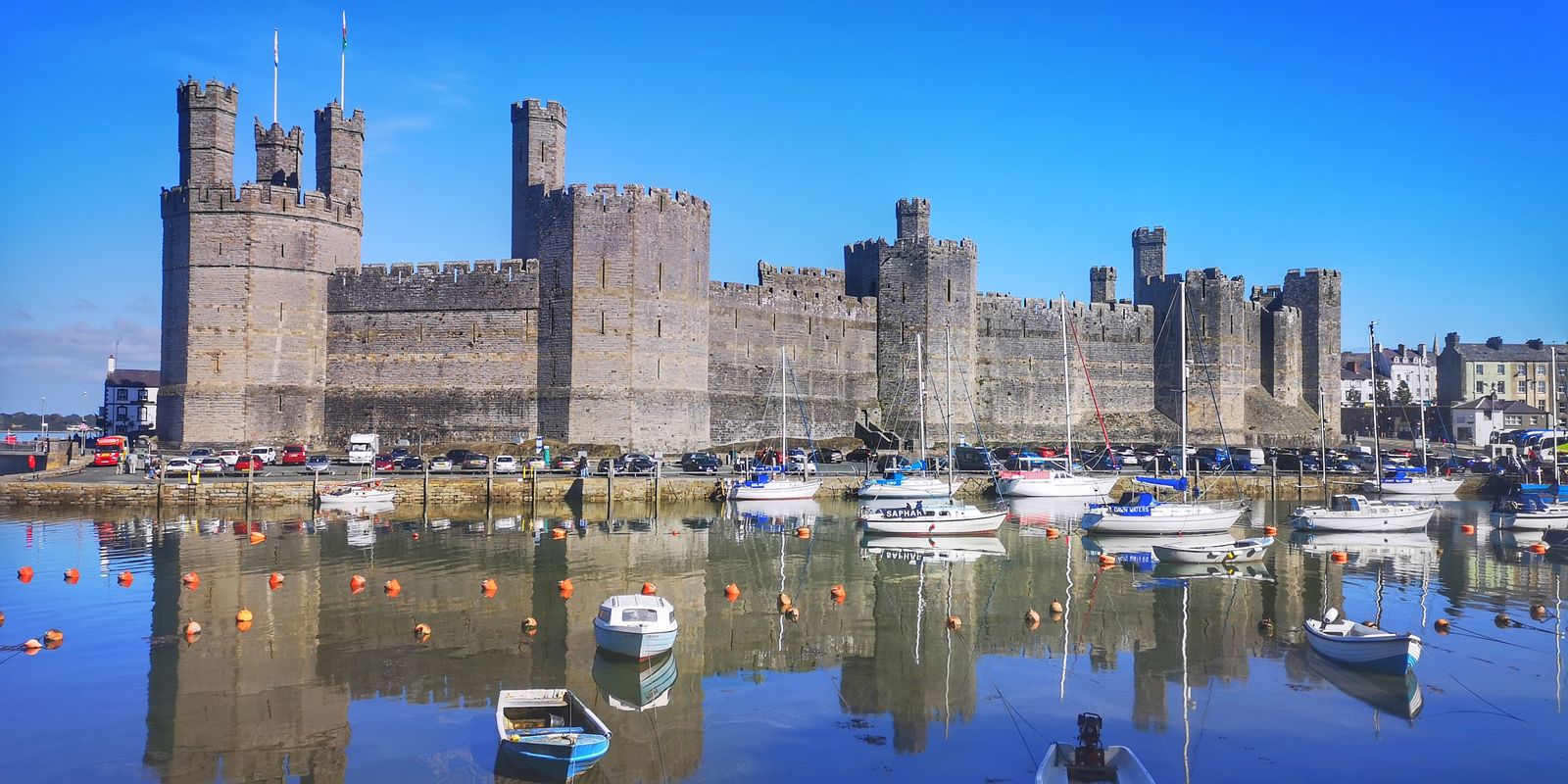
The surrounding region is defined by its extraordinary concentration of medieval castles — Edward I's Iron Ring of fortifications, including Caernarfon, Conwy, Beaumaris and Harlech, represent some of the finest surviving examples of medieval military architecture anywhere in Europe. Caernarfon Castle, a UNESCO World Heritage Site, stands less than 20 kilometres from Holyhead and is an essential destination for anyone with an interest in history or architecture.
Welsh culture — language, music, poetry and fierce local identity — is more alive in North Wales than almost anywhere else in the country. You will hear Welsh spoken in shops and streets, see it on every road sign, and sense a pride in heritage that makes this corner of Britain feel genuinely distinct.
Top things to do in Holyhead on a cruise stopover
Private North Wales Sightseeing Tour
A private guided sightseeing tour is the most effective way to experience North Wales from Holyhead in a single day, giving you the flexibility to focus on the landscapes, castles and communities that matter most to you. North Wales is a region of remarkable contrasts — the massive walls of Caernarfon Castle rising above the Menai Strait, the slate-grey peaks of Snowdonia reflected in mountain lakes, the quiet hedgerow lanes of Anglesey winding to hidden coves — and a private tour allows you to move between these worlds at your own pace. Guides with deep local knowledge bring the region's layered history to life: Iron Age hill forts, the druidic tradition centred on Anglesey, Edward I's 13th-century conquest and his ring of stone fortresses, the Industrial Revolution's slate quarries, and the living Welsh culture that endures in language and ceremony. The private format means the itinerary adapts to your interests on the day.
Caernarfon Castle: Edward I's Masterpiece
Among all the medieval fortresses of North Wales, Caernarfon Castle stands apart for its sheer scale, symbolic power and extraordinary state of preservation. Built by Edward I from 1283 following his conquest of Wales, the castle was designed as an unambiguous statement of English dominance — its polygonal towers, banded stonework and eagle turrets inspired by the walls of Constantinople. The castle was also the birthplace of the first Prince of Wales (the future Edward II) in 1284 — a title held by the heir to the British throne ever since, most recently invested here in 1969. Walking the battlements reveals panoramic views across the Menai Strait to Anglesey, and the castle's museums within the towers provide detailed context on Welsh history and the complex story of the conquest.
Snowdonia: Britain's Most Dramatic Mountain Landscape
Eryri (Snowdonia) National Park covers 2,130 square kilometres and contains fifteen peaks over 900 metres, including Yr Wyddfa (Snowdon) at 1,085 metres — the highest mountain in England and Wales. The park's glacially sculpted valleys, mountain lakes, ancient oak woodlands and dramatic ridges make it one of the most striking upland landscapes in the British Isles. For cruise visitors, the most accessible way to experience Snowdonia is by road through the mountain passes — the Llanberis Pass and Ogwen Valley offer spectacular scenery without strenuous walking. The Snowdon Mountain Railway (weather permitting) ascends from Llanberis to the summit on a Victorian rack-and-pinion line, with extraordinary views on clear days. The park's villages — Betws-y-Coed, Beddgelert and Capel Curig — each have distinct character and make rewarding stops.
Anglesey: The Mother of Wales
Known in Welsh as Ynys Mon, Anglesey was historically called 'the Mother of Wales' for its fertile farmland that fed the medieval population. It is an island of immense character — ancient standing stones and burial chambers, lighthouse-topped headlands, long sandy beaches and a coastal path circumnavigating the entire island. The island's coastline is designated an Area of Outstanding Natural Beauty. South Stack Lighthouse on the western cliffs offers one of the most dramatic viewpoints in Wales, with seabird colonies nesting below. Beaumaris on the eastern shore contains another of Edward I's great castles — considered by many historians to be the most technically perfect concentric castle ever built. The charming waterfront town also has independent cafes, a Victorian pier and views across to the Snowdonia peaks.
Conwy: A Medieval Town Frozen in Time
Conwy, on the North Wales coast approximately 45 kilometres from Holyhead, is one of the best-preserved medieval walled towns in Europe. The town walls — built simultaneously with the castle between 1283 and 1289 — survive almost entirely intact, encircling a compact streetscape of independent shops, galleries and restaurants still following the medieval street plan. Conwy Castle itself is a UNESCO World Heritage Site, with eight massive circular towers and spectacular views from the battlements across the estuary to the Great Orme headland. The town's quayside is charming — the harbour contains the world's smallest house (recorded in the Guinness World Records) and the estuary views are among the finest in Wales.
The Menai Strait and Telford's Bridges
The narrow tidal channel separating Anglesey from the Welsh mainland has shaped this region for millennia — a natural defensive barrier for ancient Celtic communities and a persistent engineering challenge for those seeking to connect the island to the mainland. Thomas Telford's elegant suspension bridge, completed in 1826, was the world's first major iron suspension bridge, opening the route from London to the Irish ferries at Holyhead. Just downstream stands Robert Stephenson's tubular Britannia Bridge (1850), carrying the main rail line. Seen together from the Anglesey shore, these two Victorian engineering masterpieces against the backdrop of the strait and Snowdonian peaks create one of the most evocative industrial-heritage landscapes in Britain. The Menai Strait is also a rich marine environment, popular with sea kayakers and abundant in wildlife.
Holyhead travel tips
Check the Weather — and Pack for All of It. North Wales is one of the wetter parts of the UK, and Snowdonia mountain weather can change rapidly even in summer. A forecast of sunshine in Holyhead does not guarantee the same in the Ogwen Valley. Always carry a compact waterproof jacket, regardless of the morning sky. Conversely, on a clear day the views from the mountain passes and castle battlements are genuinely spectacular — the changeable nature of Welsh weather is part of its drama.
Welsh Language: Say It Right, It Matters. Welsh is spoken as a first language by approximately 30% of North Wales's population and is very much alive in daily life. Locals genuinely appreciate any effort: 'diolch' (dee-olch) means thank you, 'bore da' (bor-eh dah) is good morning, and 'hwyl' (hoo-il) is a warm farewell. Welsh place names follow consistent rules: 'w' and 'y' are vowels, 'll' is a lateral fricative, and 'ch' is as in Scottish 'loch'. Road signs are always bilingual.
Caernarfon Castle: Book Entry in Advance. Caernarfon Castle is managed by Cadw (Historic Environment Wales) and can draw significant visitor numbers during summer cruise season. Entry tickets are best purchased online in advance to avoid queuing — particularly advisable when multiple ships are in port simultaneously. The castle is large and the exhibits detailed; allow at least 90 minutes to do it justice, and build in time to walk the town walls extending from the castle into the town.
Snowdon Summit: Manage Expectations. The Snowdon Mountain Railway (seasonal, weather-dependent) can be fully booked weeks in advance in peak season — check availability before your ship arrives. Walking routes to the summit and back take 4–6 hours minimum and require proper footwear. For cruise visitors with limited time, the mountain passes and valley scenery are more time-efficient and nearly as spectacular for those not intent on reaching the summit itself.
Holy Island's Own Attractions Are Closer Than You Think. South Stack Lighthouse and RSPB Reserve, just 5 km from the port, offers dramatic cliff-top scenery, abundant seabirds (including puffins in season, April–July) and views to Ireland. The Holyhead Mountain Iron Age Hut Circles, one of Wales's largest prehistoric settlements, sit directly adjacent to South Stack. These destinations require no long drive and make a rewarding alternative or complement to a mainland excursion.
Shopping for Welsh Crafts: Know What's Authentic. North Wales has a genuine craft tradition — slate products from the Llechwedd quarries, Welsh wool and tweed from small mills, carved wooden lovespoons, local ceramics and jewellery. Look for items marked as made in Wales rather than mass-produced tourist goods. Caernarfon's town centre and Conwy's walled town both have good independent shops. Anglesey sea salt and Penderyn Welsh whisky make excellent, genuinely local gifts.
Port Facts Every Cruiser Needs To Know
Holyhead shore excursion FAQs
Cruise ships dock at Holyhead Port on Holy Island, connected by road and bridge to the main island of Anglesey. The port is a working commercial ferry terminal primarily serving the Dublin–Holyhead route, so facilities are functional rather than leisure-oriented. The town centre is within walking distance, but most cruise visitors head to outlying attractions via organised transport. Your ship's tour desk will provide specific pier information.
For most visitors, Caernarfon Castle is the standout priority — one of the finest medieval fortresses in Europe, a UNESCO World Heritage Site, and just 20 kilometres from the port. Those more drawn to natural scenery should consider a drive through Snowdonia's mountain passes, which offers spectacular views without the commitment of walking. A private guided tour allows you to combine both highlights if your time ashore permits.
Yes, with careful planning and pre-arranged transport. A practical combination is Caernarfon Castle in the morning followed by a drive through the Llanberis Pass into Snowdonia in the afternoon, or a loop through Beddgelert and the Aberglaslyn Pass. Journey times from Holyhead to Caernarfon are approximately 25–30 minutes; from Caernarfon into the heart of Snowdonia is another 20–30 minutes.
Conwy is approximately 50 kilometres from Holyhead, around 45–55 minutes by road via the A55 expressway. Llandudno is a similar distance along the same route. Beaumaris Castle on Anglesey is only about 25 kilometres from Holyhead — a significantly quicker journey that makes it a very manageable half-day excursion, easily combined with exploring the Anglesey coast.
A private sightseeing tour of the Anglesey coast can include South Stack Lighthouse, the prehistoric hut circles on Holyhead Mountain, the Newborough Warren and Llanddwyn Island area, and the charming town of Beaumaris with its castle and harbour. The Anglesey Coastal Path runs 210 kilometres around the island, but cruise visitors can experience compelling sections by car with short walks. This makes a relaxed, scenically rewarding alternative to the mainland for those who prefer coastal to mountain scenery.
Most restaurants, cafes, shops and major attractions accept credit and debit cards, including contactless payment. However, rural car parks, some village cafes, market stalls and heritage sites may prefer cash. It is worth carrying £20–30 in pound sterling as backup. ATMs are available in Holyhead town centre and in major towns such as Caernarfon, Bangor and Conwy.
Yes — North Wales has one of the highest concentrations of Welsh speakers in the country. Holyhead and Anglesey in particular are strongly Welsh-speaking communities where Welsh is the dominant community language. All road signs are bilingual. This is one of the few places in Wales where Welsh is spoken more widely than English in daily life, giving the area a cultural distinctiveness that many visitors find genuinely fascinating.
South Stack Cliffs RSPB Reserve, 5 km from the port, hosts guillemots, razorbills, choughs and puffins (in season April–July). Peregrines nest on the headland. The Menai Strait is excellent for grey seals and wading birds. Newborough Beach in southern Anglesey is one of Wales's finest, with red kites often visible overhead. Dolphins are occasionally seen in the waters around Anglesey, particularly in the deeper channels.
The port itself is flat and accessible. However, many of North Wales's key attractions involve uneven terrain — Caernarfon Castle has extensive walking on cobblestones and spiral staircases, Snowdonia's passes involve steep paths, and South Stack requires around 400 steps. Beaumaris Castle, Conwy's quayside and Llandudno's promenade are among the more accessible options. A private tour allows the itinerary to be tailored to specific mobility requirements.
Holyhead has been a crossing point to Ireland since at least Roman times — the Romans built a fort here (Caer Gybi) to guard the western route, and the medieval church of St Cybi stands within its walls in the town centre, one of the few buildings in Wales still enclosed by Roman walls. The modern port grew dramatically with Telford's A5 road and the railway in the 19th century, cementing Holyhead's role as Britain's primary crossing point to Dublin.
Filters
Select a filter to refine results.
Tour Type
Tour Activity
 Cart
Cart
 USD
USD GBP
GBP AUD
AUD EUR
EUR CAD
CAD