



Tours in Zeebrugge (Bruges)


Cruising to Zeebrugge (Bruges) in a group?
Skip the crowded ship excursion bus. One dedicated planner will design a private shore experience around exactly what your group wants — coordinated from first enquiry to the moment you're back on board. More memorable, more flexible, and more affordable than you might expect. Spend less time organising, more time enjoying.
Explore Group Travel →Cruising to Zeebrugge (Bruges)
Zeebrugge is a working port on Belgium's North Sea coast, but its significance for cruise passengers lies almost entirely in what lies 15 kilometres inland: Bruges, one of the most completely preserved medieval cities in Europe and a UNESCO World Heritage Site since 2000. The port town itself is functional rather than scenic, and most visitors are wise to head directly to the historic centre rather than linger at the quayside. What awaits in Bruges more than compensates for the brief transfer.
Bruges reached its medieval zenith in the 13th and 14th centuries as the commercial capital of northern Europe, the meeting point of Hanseatic trade routes and the English wool trade. When the Zwin channel silted up in the late 15th century and commerce shifted to Antwerp, Bruges quietly froze in architectural time. The result, five centuries later, is a city whose canal-laced medieval street plan, Gothic guild houses, cloth halls, and belfries survive in a state of preservation extraordinary for any European city of comparable historic importance. The Market Square (Markt) and the adjoining Burg square form one of the most harmonious medieval civic ensembles on the continent.
Beyond its architectural grandeur, Bruges is deeply embedded in Belgian culinary culture. Chocolate shops line the medieval lanes — not tourist trinkets but serious artisan confectioners using Belgian couverture chocolate of genuine quality. The Halve Maan (Half Moon) brewery, operating since 1564 in the medieval heart of the city, produces Bruges Zot and Straffe Hendrik ales and offers guided tastings. The city's restaurants serve moules-frites and Flemish stew in dining rooms with painted beam ceilings and tiled hearths, and waffle stands at every corner are a reminder that Belgium's most famous street food is best eaten fresh, dusted simply with icing sugar.
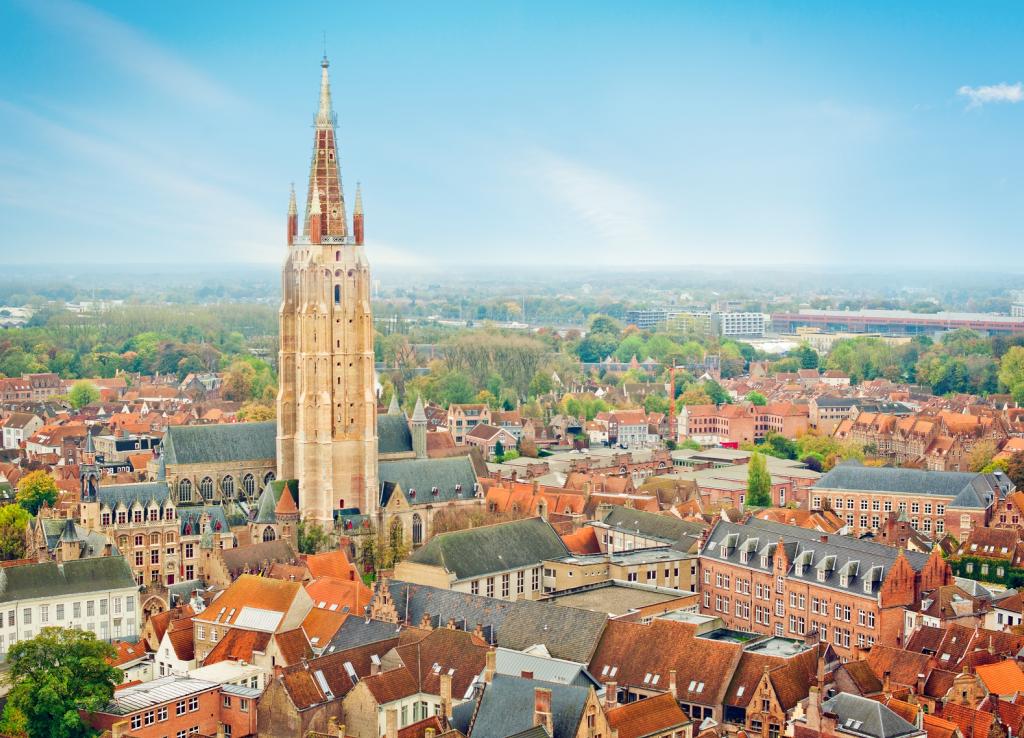
For cruise passengers with a full day, Bruges absorbs six to eight hours comfortably — the Groeningemuseum alone, housing the finest collection of Flemish Primitive paintings in existence, can occupy a devoted hour or more. Canal boat tours, a climb to the top of the Belfry, the Basilica of the Holy Blood, the Begijnhof courtyard, and the lace centre each add depth to the experience. The city is compact, almost entirely flat, and navigable on foot — making it one of the most accessible and rewarding destinations on any North Sea or Atlantic cruise itinerary.
Top things to do in Zeebrugge (Bruges) on a cruise stopover
The Markt and the Belfry: Bruges's Iconic Heart
The Markt is Bruges's central square and its symbolic heart — a broad, cobbled expanse lined with guild houses and dominated on its south side by the Belfry, a 13th-century bell tower that rises 83 metres above the rooftops and has served as the civic watchtower and treasury of the city for eight hundred years. The climb to the top — 366 narrow steps — is genuinely rewarding: the panorama across a sea of red-brick rooftops, canal lines, and church spires extending to the Flemish plain gives the medieval city its full spatial context. The carillon of 47 bells in the Belfry plays automatically and on occasion by a resident carillonneur, and the mechanism room halfway up is open to visitors. The square itself, particularly in the morning before it fills with visitors, has a grandeur and architectural coherence rarely matched in northern European cities.
Canal Boat Tours: Bruges from the Water
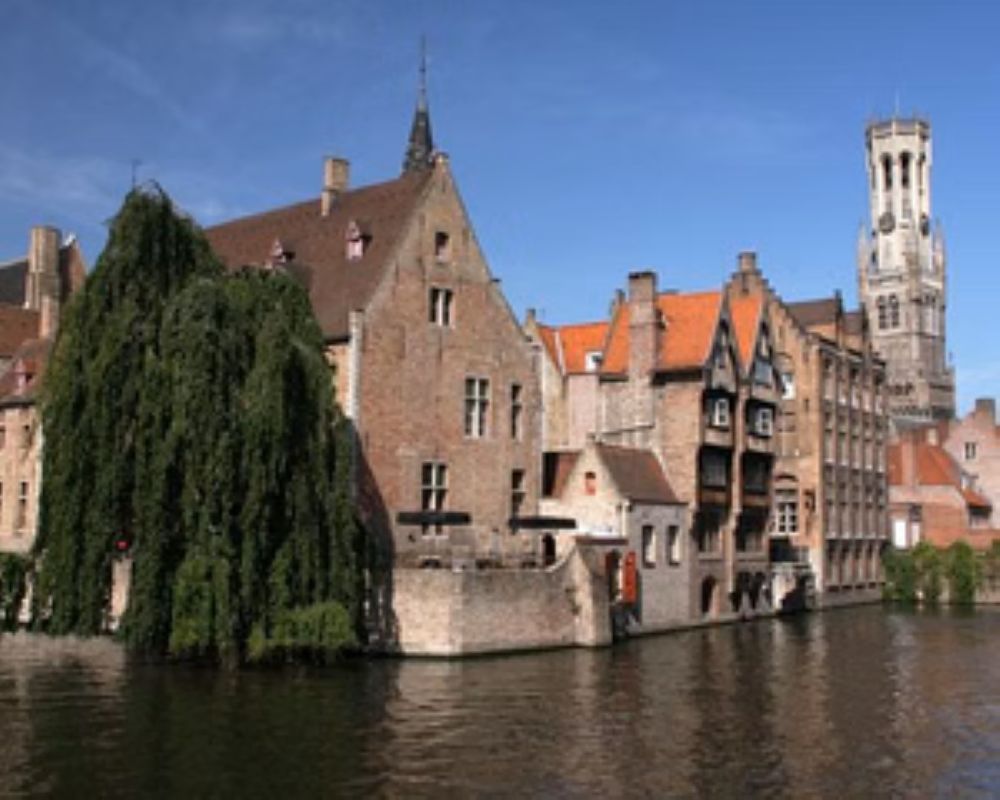
Bruges earned the epithet 'Venice of the North' from its network of medieval canals — the Reie and its tributaries — that once served as commercial arteries linking the city to the sea. Today, small covered boats operate regular 30-minute tours departing from several landing stages near the Burg and Rozenhoedkaai. The water-level perspective reveals a completely different city: the backs of medieval warehouses, weeping willows trailing into jade-green water, the Boniface Bridge (a miniature stone arch almost hidden by vegetation), and the great spire of the Church of Our Lady rising above everything. The tours run regularly throughout the day and accommodate small groups per boat; queues can be significant at peak midday hours, making a morning departure advisable.
The Burg and the Basilica of the Holy Blood
Adjacent to the Markt but quieter and architecturally even more varied, the Burg square contains centuries of civic and religious ambition pressed into a single space. On one side, the Gothic Town Hall (1376) is the oldest in the Low Countries; on another, the Renaissance Court of Chancery; and tucked into a corner, the Basilica of the Holy Blood — a double chapel whose lower Romanesque level dates from the 12th century and upper Gothic level from the 15th, topped by a 19th-century neo-Gothic facade. The basilica houses a reliquary said to contain a cloth bearing drops of Christ's blood, brought to Bruges by the Count of Flanders after the Second Crusade. Whether venerated as a relic or admired as an exceptional example of medieval goldsmithing, the reliquary is displayed every Friday and during the famous Procession of the Holy Blood, which takes place each May.
Flemish Primitive Masterpieces at the Groeningemuseum
The Groeningemuseum holds one of the most significant collections of early Flemish painting in existence, covering six centuries from the 15th century to the present. The core of the collection is the Flemish Primitive works — paintings by Jan van Eyck, Hans Memling, Gerard David, and Hugo van der Goes — produced in Bruges during its commercial golden age, when the city's merchant patrons commissioned works of extraordinary technical refinement and emotional intensity. Van Eyck's Madonna with Canon van der Paele (1436) is the single most important painting in the collection: a work of such microscopic detail and luminous colour that it rewards long, close examination. The museum is not large, and for visitors with an interest in Western art history, the time spent here is among the most rewarding of any afternoon in northern Europe.
Belgian Chocolate, Beer, and Artisan Food Culture
Bruges is among the best cities in the world to engage seriously with Belgian chocolate. The city has dozens of independent chocolatiers producing handmade pralines — the Belgian invention of filled chocolate confections — using high-quality couverture in flavours from salted caramel to violet ganache. The Halve Maan brewery on Walplein has been producing ale in the medieval city since 1564 and offers guided tours with tastings of its Bruges Zot and Straffe Hendrik ales; its underground pipeline, running under the city streets to deliver beer to a bottling plant outside the walls, is a recent engineering curiosity that has become part of the tour. Beer bars throughout the old town serve hundreds of Belgian varieties; Belgian frites from the city's traditional friteries — served in a cone with mayonnaise — are a distinct and serious culinary tradition in their own right.
The Begijnhof and the Quiet Corners of Bruges
Beyond the main squares and canal routes, Bruges contains spaces of surprising stillness. The Begijnhof — a walled courtyard of whitewashed houses arranged around a tree-shaded green — was founded in 1245 as a community for Beguines, lay religious women who lived communally without taking formal vows. Today it is home to a community of Benedictine nuns and is entered through a low gate that opens into a quiet that feels genuinely removed from the surrounding city. The adjacent Minnewater (Lake of Love), a small medieval reservoir fringed by swans and willows, is one of the most photographed spots in the city. The lace centre (Kantcentrum) in the Sint-Anna quarter preserves and demonstrates the traditional Flemish bobbin-lace tradition, with live demonstrations by skilled makers — a craft tradition inseparable from Bruges's identity for five centuries.
Zeebrugge (Bruges) travel tips
Arrive at the Belfry Early in the Day. The Belfry climb is one of Bruges's most rewarding experiences, but the 366-step tower has a limited capacity and queues at peak hours (10am–2pm in summer) can mean waits of 30 minutes or more. Arriving at opening time or later in the afternoon significantly reduces waiting. Tickets can be purchased on the day at the entrance on the Markt side; the climb involves a genuinely narrow staircase in places, and those with concerns about height or confined spaces should be aware of this.
Choose Your Chocolate Shop with Care. Bruges's canal-side streets are lined with chocolate shops, but quality varies enormously. Look for shops that display their own production equipment and list the origin of their cocoa; large operations selling pre-packaged products of uncertain provenance are common in the tourist-heavy streets. Independent, family-run chocolatiers — of which Bruges has many — produce pralines and tablets that represent the genuine artisan tradition. Buying chocolate to take home? Keep it in a cool, dark place; Belgian chocolate melts quickly in summer temperatures.
Take the Canal Boat Tour in the Morning. Canal boat tours depart from several stages near the Burg and Rozenhoedkaai and run approximately 30 minutes. Morning departures — before the main tour groups arrive around 11am — mean shorter queues and lighter canal traffic, with good light for photography. The tour provides excellent orientation for first-time visitors, covering the main canal geography and several key landmarks from the water before you explore them on foot.
Museum Passes and Pre-Booked Entry. The Groeningemuseum and the Bruges city museums are popular, and advance tickets are available through the official Bruges tourism platform online. In high summer (July–August), pre-booking is advisable for the Groeningemuseum and for guided tours of the Halve Maan brewery. The Basilica of the Holy Blood has no entry fee for the lower chapel; the upper chapel is accessed via a separate staircase and may have a small admission charge.
Wear Comfortable Shoes for Cobblestones. Bruges's medieval streets are paved with cobblestones that are beautiful to look at but can be tiring to walk on, particularly on the irregular surfaces away from the main squares. Flat, well-soled shoes are strongly recommended. The city is overall very flat, which makes it accessible for most mobility levels, but the cobbling means wheeled luggage and some wheeled mobility aids can find certain lanes challenging.
Explore the Quieter Neighbourhoods in the Afternoon. The Markt and canal boat areas are busiest between 10am and 2pm when day-tripper buses arrive from Brussels and elsewhere. After 2pm, the volume of visitors noticeably reduces. Using the busier hours to see the Groeningemuseum or the Belfry (indoor attractions), then exploring the quieter Sint-Anna quarter, the Begijnhof, and the Minnewater in the afternoon, gives the best of both the major sights and the city's more intimate character.
Port Facts Every Cruiser Needs To Know
Zeebrugge (Bruges) shore excursion FAQs
Zeebrugge cruise terminal is approximately 15 kilometres from the centre of Bruges. The journey by road takes around 20 to 30 minutes depending on traffic. Bruges is easily reachable with pre-arranged transport from the port. Once in Bruges, the historic city centre is compact and entirely walkable.
Yes — Bruges's medieval centre is exceptionally compact and almost entirely flat, making it one of the most walkable historic cities in northern Europe. The Markt, Burg, Groeningemuseum, canal boat stages, Begijnhof, and Minnewater are all within comfortable walking distance of one another. The main challenge is the cobblestone paving, which while attractive can be tiring on the feet; flat, well-soled shoes are recommended.
The Belfry (Belfort) is Bruges's most iconic medieval tower, rising 83 metres above the Markt. Dating from the 13th century, it served as the city's civic watchtower and housed its treasury and archives. The climb involves 366 narrow steps and passes the carillon mechanism and the treasury rooms before emerging onto a panoramic observation platform with views over the entire city and surrounding Flemish plain. It is widely considered one of the most rewarding climbs of any civic tower in Europe and is strongly recommended for anyone without mobility concerns.
Ghent is a feasible extension for passengers with a long port day — around seven or more hours ashore. From Bruges railway station (about 2 km from the medieval centre), trains run frequently to Ghent Sint-Pieters station in approximately 25 minutes. Ghent offers another outstanding medieval city with its own castle, canal system, and Flemish art. Brussels is possible but less recommended, as the train journey is approximately an hour each way and significantly reduces time in both Bruges and Brussels. Most passengers find Bruges alone easily fills a six-to-eight hour day.
Belgian chocolate has a specific legal definition within Belgium — it must be produced using Belgian processing standards and genuine cocoa butter without vegetable fat substitution. The praline, a chocolate shell filled with flavoured ganache, cream, or nut paste, was invented in Brussels in 1912 and remains the signature Belgian confection. In Bruges's independent chocolatiers, pralines are made fresh daily using high-quality single-origin chocolate; the difference from mass-produced alternatives is immediately apparent. Visiting a quality chocolatier and selecting a mixed box of fresh pralines is one of the most genuinely worthwhile culinary experiences in the city.
The Flemish Primitives are a school of 15th and early 16th-century painters who worked in cities including Bruges, Ghent, and Brussels during the period of Flemish commercial and cultural dominance. Artists including Jan van Eyck, Hans Memling, Gerard David, and Rogier van der Weyden developed revolutionary oil painting techniques — layering transparent glazes to achieve luminous colour and microscopic detail — that transformed European art. The Groeningemuseum in Bruges holds the world's finest collection of these works, including van Eyck's Madonna with Canon van der Paele, one of the most technically accomplished paintings of the 15th century.
The Basilica of the Holy Blood is a double-chapel church on the Burg square in Bruges, housing a reliquary said to contain a cloth bearing drops of Christ's blood brought from Jerusalem by the Count of Flanders after the Second Crusade in 1150. The lower Romanesque chapel dates from the 12th century and is one of the finest surviving examples of Romanesque architecture in Belgium. The upper Gothic chapel was rebuilt in the 15th century and the reliquary itself — a cylinder of rock crystal and gold set in medieval and later goldsmithing — is an important example of medieval liturgical art. The relic is venerated every Friday and carried through the city in the Procession of the Holy Blood each May.
Zeebrugge has limited tourist attractions but does have a seafront promenade and a maritime theme park (Seafront Zeebrugge) featuring a former Russian submarine open for exploration. The North Sea coast around Zeebrugge has wide sandy beaches. For most cruise passengers, however, the time ashore is better spent in Bruges, which offers incomparably more in terms of history, culture, food, and visual interest. The town is not without character, but it is a working port and industrial centre rather than a heritage destination.
Bruges is in the Dutch-speaking Flemish region of Belgium, and the local language is Flemish Dutch. However, English is universally spoken in tourist-facing settings — shops, restaurants, museums, hotels, and tour operations — to a very high standard. French is also widely understood. Visitors from any English-speaking country will encounter no language difficulties in Bruges; signage is typically in Dutch with English frequently added in the tourist centre.
Bruges works well for families. The city is flat and compact, making it manageable with young children. Canal boat tours are engaging for most ages, the Belfry climb is adventurous, and the chocolate shops provide obvious enthusiasm. The Halve Maan brewery tour is adult-focused. The Begijnhof and Minnewater with its swans are gentle and picturesque spaces that appeal across age groups. Families may find the cobblestone streets challenging with pushchairs, and restaurant dining with young children is generally accommodated in a relaxed Flemish style.
Filters
Select a filter to refine results.
Tour Type
Tour Activity
 Cart
Cart
 USD
USD GBP
GBP AUD
AUD EUR
EUR CAD
CAD