



Tours in Chiang Mai


Cruising to Chiang Mai in a group?
Skip the crowded ship excursion bus. One dedicated planner will design a private shore experience around exactly what your group wants — coordinated from first enquiry to the moment you're back on board. More memorable, more flexible, and more affordable than you might expect. Spend less time organising, more time enjoying.
Explore Group Travel →Cruising to Chiang Mai
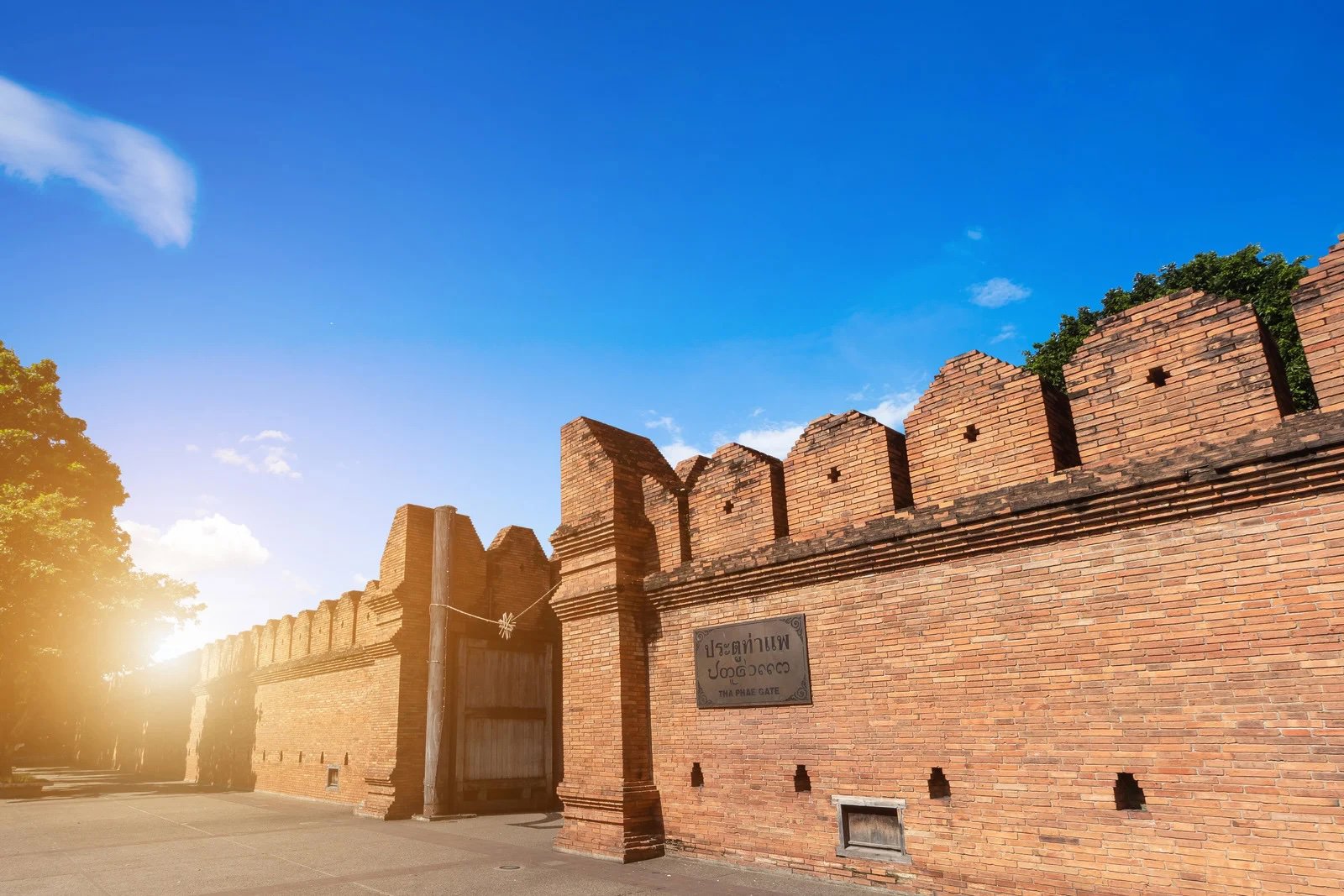
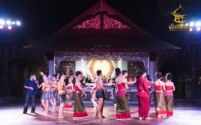
Chiang Mai sits in a broad valley some 700 kilometres north of Bangkok, ringed by forested ranges that once formed the frontier of the ancient Lanna kingdom. Founded in 1296, the city retains its original moat and rampart walls, and within that square perimeter you will find more than 30 working temples, their tiered rooflines still gilded by centuries of royal patronage. This is not a city that performs its heritage for visitors — monks still collect alms at dawn, artisan quarters still produce lacquerware and hand-painted umbrellas, and the rhythm of daily life has a deliberateness that the capital long ago surrendered.
For cruise travellers, Chiang Mai typically appears as an extension of an itinerary anchored in Bangkok — either as an overnight shore excursion by air or as a pre- or post-cruise stay of two to three nights. The flight north takes roughly 80 minutes, making it achievable in a single generous day if you are willing to move efficiently. That said, the city genuinely rewards a slower pace: the old quarter alone could absorb an entire morning, and the surrounding countryside — elephant sanctuaries, hilltribe villages, terraced rice fields — invites early starts.
The culinary tradition here differs markedly from the central Thai food most international visitors know. Khao soi, a coconut-curry noodle soup with Burmese roots, is the dish you will encounter everywhere and should order repeatedly. The Saturday and Sunday walking markets along Wualai and Ratchadamnoen roads draw local vendors selling dishes, crafts, and produce that supermarkets have not yet homogenised. These markets are worth planning an evening around.
Chiang Mai's cultural calendar adds another dimension. The Yi Peng lantern festival in November, when thousands of paper lanterns rise above the Mae Ping River, draws visitors from across the region. Songkran, the Thai New Year celebrated in April, is celebrated here with particular exuberance — water battles begin early and end late. Even outside these events, the city's steady pace of temple festivals, monastery ordinations, and neighbourhood ceremonies means almost any visit will overlap with something genuine.
Top things to do in Chiang Mai on a cruise stopover
The Old City Temple Circuit
Within the square moat, a cluster of Lanna-era temples forms the spiritual core of the city. Wat Phra Singh houses the revered Phra Singh Buddha image in a bot of exquisite proportions, its exterior carved panels painted in the deep red and gold palette characteristic of northern Thai craftsmanship. A ten-minute walk away, Wat Chedi Luang centres on a partially ruined 15th-century chedi that once stood 82 metres — earthquake damage in 1545 reduced it to its present silhouette, which many visitors find more atmospheric than a restored structure would be. The City Pillar Shrine in the chedi's grounds is a working place of worship; dress modestly (shoulders and knees covered) and move quietly. Early morning, when monks are present and light filters through the surrounding trees, is the best time at both sites.
Doi Inthanon National Park: Thailand's Rooftop and Royal Twin Pagodas
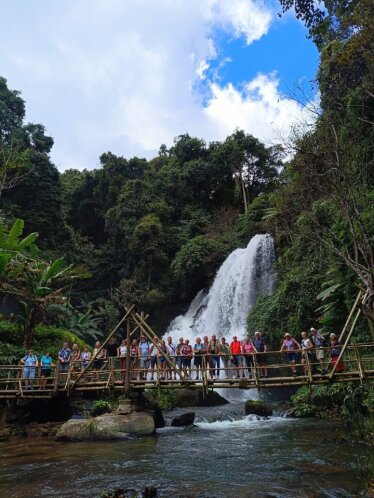
At 2,565 metres, Doi Inthanon is Thailand's highest peak — a mountain national park 58 kilometres south-west of Chiang Mai that delivers an ecosystem entirely different from the lowland city. The park protects dense montane forest, cloud-level hiking trails, and the country's most impressive waterfalls: Wachirathan Falls drops 70 metres in a single curtain audible from the approach road; Mae Ya Falls, considered the most beautiful in Thailand, cascades over limestone shelves into a broad plunge pool. Near the summit, the Royal Twin Chedis — built to honour the King and Queen on their respective birthdays — stand in manicured gardens at over 2,500 metres, offering panoramic views across the mountain range when cloud permits. The summit area hosts Hmong and Karen hill tribe villages where traditional weaving and silver jewellery are sold directly by the makers. Morning temperatures near the peak can reach 10–15°C — bring a light layer regardless of how warm it feels in Chiang Mai.
Sunday Walking Street on Wualai Road
Every Sunday evening, Wualai Road — the old silver-smithing quarter south of the old city — transforms into a walking market that runs from approximately 16:00 until 22:00. Unlike the Night Bazaar (which is open nightly and oriented toward mass tourism), Wualai draws local craftspeople, food vendors, and street performers. You will find hand-hammered silverware, cotton textiles from northern villages, paintings by art school graduates, and grilled corn alongside bowls of khao soi. The pace is leisurely, the crowd a genuine mix of residents and visitors. A similar market takes place on Ratchadamnoen Road through the old city on Saturday evenings.
Chiang Mai's Handicraft Villages: Lanna Artisan Traditions
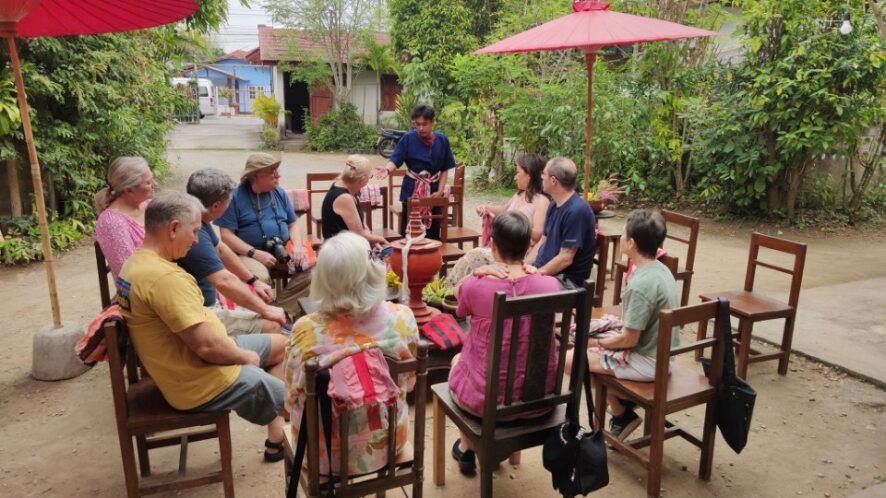
The road south of Chiang Mai along the Bo Sang–San Kamphaeng craft corridor is home to a cluster of villages, each specialising in a different traditional craft: Bo Sang for hand-painted paper parasols produced by the same family workshops for four generations; San Kamphaeng for silk weaving where you can watch the full process from cocoon to finished fabric; Baan Tawai for wood carving in teak and jackfruit; and Chiang Mai's silver quarter, where hill-tribe-style jewellery is made in small workshops you can walk through. These are genuine production centres rather than tourist villages — the goods are made here and sold to retailers across Thailand and internationally. Prices are competitive, quality is verifiable by watching the work, and the artisans are accustomed to visitors observing. The corridor is 15–20 minutes from the old city by road. Lacquerware in black and gold — another Lanna speciality — is produced in several workshops near Chiang Mai's Night Bazaar.
A Thai Cooking Class
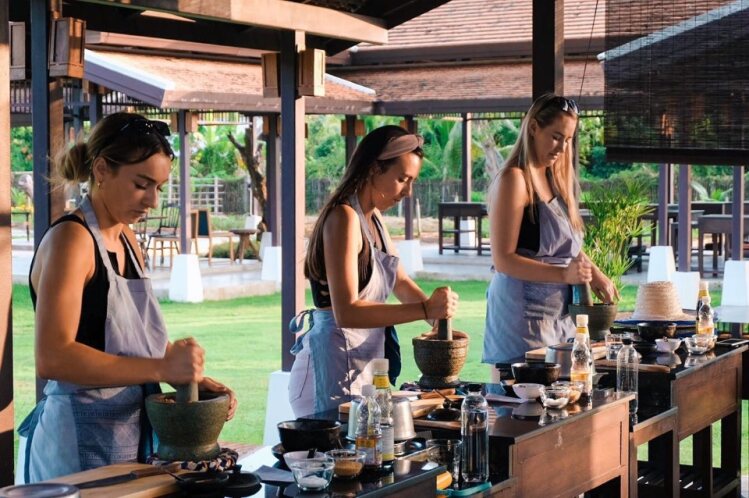
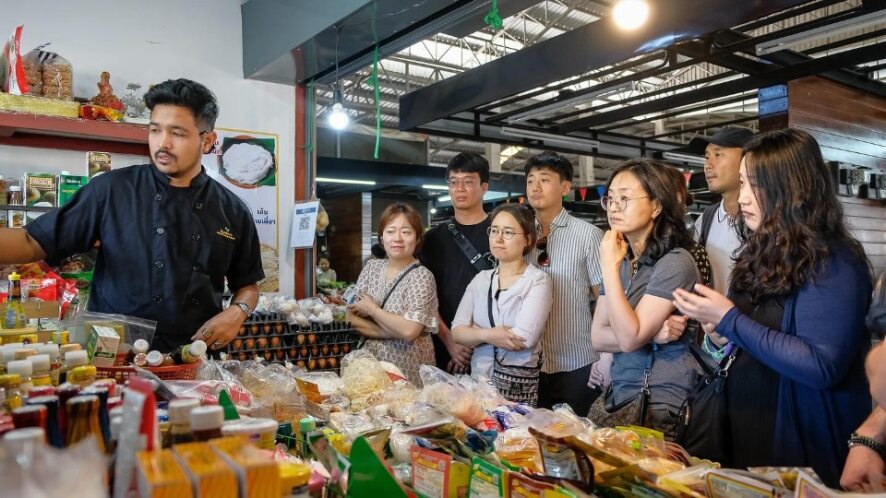
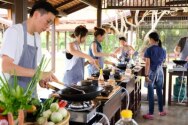
Northern Thai cuisine — coconut-rich curries, herb-laden larb, the ubiquitous khao soi — deserves more than a single meal. Chiang Mai's cooking school scene is well developed, ranging from half-day morning classes that include a market tour to longer afternoon sessions. Most classes cover four to five dishes and end with a meal of what you have cooked. Look for small-group sessions (six to eight people maximum) held in gardens or working kitchens rather than production-line tourist facilities. Many schools operate in the Nimman and Santitham neighbourhoods north of the old city. A four-hour class leaves sufficient time to explore the old city before or after, making it a manageable addition to a single-day visit.
Nimman: The Neighbourhood Beyond the Old City
The Nimmanhaemin Road area, known locally as Nimman, sits about 2 kilometres west of the old city moat and functions as Chiang Mai's contemporary cultural quarter. Independent coffee roasters, design shops, architecture studios, and restaurant concepts occupy repurposed shophouses along the main road and its sois. Maya Mall and the adjacent One Nimman development concentrate the neighbourhood's commercial energy without overwhelming its character. The area is largely the creation of Chiang Mai University graduates who chose to remain in the city — the creative sensibility reflects that. It makes a natural complement to a morning spent in the old city: ancient in the morning, contemporary in the afternoon, with excellent coffee throughout.
Chiang Mai travel tips
Temple Dress Code: Bring a Sarong. Every temple in Chiang Mai — and there are dozens — requires shoulders and knees to be covered. Many sites lend sarongs at the entrance, but the supply runs short during peak hours and you may encounter less hygienic options. Carry a lightweight scarf or sarong in your bag and you will move through temple entrances without delay. Sandals are acceptable; shoes are removed at building entrances regardless.
Lanna Culture: How Chiang Mai Differs from Central Thailand. Chiang Mai was the capital of the independent Lanna Kingdom for five centuries before it became part of Siam in 1892, and it has retained a cultural identity distinct from Bangkok's. The local dialect (Kham Mueang) is still spoken by older residents alongside Central Thai. Lanna temple architecture is distinguishable by its low, sweeping multi-tiered roofs and wooden lacquerwork — different from the spired, gilded style dominant in Bangkok. Local food reflects northern influences: khao soi (a coconut-curry noodle soup, Chiang Mai's most celebrated dish), sai oua (herbal northern pork sausage), and nam prik noom (roasted green chilli dip) are northern specialities rarely found in the south. At temples, the same dress etiquette applies as elsewhere in Thailand — knees and shoulders covered — but the atmosphere in Chiang Mai's older temples tends to be quieter and less crowded than Bangkok's major sites. A basic northern greeting, 'Sabai dee baw?' (are you well?), is warmly received.
Negotiate Songthaew Fares Before You Board. Shared red songthaews follow semi-fixed routes, but solo or small-group hire operates on negotiated fares. Establish the price clearly before the journey begins — show the driver your destination on a map if language is a barrier. As a rough guide, cross-city journeys within the moat area should cost 40–60 THB per person.
Visit Doi Suthep Early or Late in the Day. Tour buses arrive at Doi Suthep from mid-morning onwards, and the temple grounds can become genuinely crowded between 10:00 and 14:00. An early start — arriving at the base by 08:00 — gives you the best light, quieter terraces, and a more contemplative experience. Alternatively, an afternoon visit after 15:00 catches the golden-hour glow on the chedi and avoids the main coach traffic. Allow extra time for the return journey if you plan to be back for an evening market.
Stay Hydrated and Carry Small Change. Chiang Mai is warm year-round, and temple circuits involve more walking in direct sun than most visitors anticipate. Carry water; refill stations near the main temples are inexpensive. Street food and market vendors often cannot break 500 THB notes — keep a supply of 20s and 50s from your first ATM withdrawal. The ATMs inside airport arrival halls typically dispense mixed denominations.
The Night Bazaar Is Convenient, Not Essential. The Night Bazaar on Chang Khlan Road operates every evening and is easy to find, but it caters primarily to visitors and the goods — mass-produced hill-tribe textiles, replicated silverware, tourist-oriented souvenirs — reflect that. For more considered purchases, the Saturday and Sunday walking markets on Ratchadamnoen and Wualai roads offer better quality, more authentic provenance, and more direct contact with makers. If your visit falls on a weekday, the Talat Warorot market near the Mae Ping River is where locals shop and gives a truer sense of the city's daily commerce.
Port Facts Every Cruiser Needs To Know
Chiang Mai shore excursion FAQs
The standard route is by air: multiple domestic carriers (Thai Airways, Bangkok Airways, Thai Lion Air, Nok Air) operate frequent flights between Bangkok's Suvarnabhumi and Don Mueang airports and Chiang Mai International Airport, with journey times of 75–90 minutes. Flights depart from early morning through late evening. Some cruise lines offer organised Chiang Mai excursions as an overnight or multi-day add-on; independent travellers can book flights and accommodation directly. The overnight train (approximately 12 hours) is a scenic alternative for pre- or post-cruise stays when time allows.
One full day is enough to experience the old city's core temples, have a proper meal, and glimpse one additional attraction — a cooking class, the Nimman neighbourhood, or the evening market. Doi Suthep and elephant sanctuaries each require a half-day and are harder to combine with a thorough old-city visit on the same day. Two nights and two full days is the minimum most visitors feel they needed in retrospect. If you have only one day, focus on the old city in the morning and choose one additional element in the afternoon rather than attempting everything.
Wat Phra Singh (within the old city, northwest corner) is the most venerated and most architecturally complete example of Lanna temple design — its library building and principal bot are outstanding. Wat Chedi Luang (old city centre) impresses through scale and history, and its grounds contain the city pillar shrine. Wat Suan Dok (west of the old city) is quieter, visited by fewer tourists, and contains white chedis housing the ashes of the Chiang Mai royal family. Wat Phra That Doi Suthep on the mountain above the city rewards the journey with panoramic views and a sense of pilgrimage. Three or four temples per day is a reasonable amount before the details begin to blur.
Elephant Nature Park in the Mae Taeng Valley (60 km north of Chiang Mai) is the oldest, largest, and most rigorously welfare-focused operation. It accommodates more visitors than smaller sanctuaries, which means busier but also well-managed. Smaller alternatives — MandaLao (day trips from the city), Patara (limited numbers, very high ratio of staff to visitors), and Elephant Freedom Village — offer more intimate experiences but require earlier booking and often higher fees. Verify that any sanctuary you consider prohibits riding, bullhooks, and performance tricks. Review recent independent visitor accounts rather than relying on aggregator listings.
Khao soi is the essential northern Thai dish: egg noodles in a coconut-cream curry broth, served with pickled mustard greens, shallots, and lime, topped with crispy fried noodles. Order it everywhere and compare. Beyond khao soi: sai oua (northern Thai sausage seasoned with lemongrass and galangal), nam prik ong (a tomato and minced pork chilli dip served with raw vegetables and crackers), larb moo (minced pork salad with toasted rice powder and herbs), and kanom jeen nam ngeow (rice noodles in a bold tomato-pork broth). The Sunday and Saturday markets offer the broadest range of these dishes in a single location.
Chiang Mai has a low rate of violent crime and is generally considered one of Thailand's safer cities for independent travel. Common issues are opportunistic: tuk-tuk drivers steering visitors toward gem shops or overpriced tailors, inflated fares when prices are not agreed in advance, and scams targeting visitors at temple entrances (often men in civilian clothes claiming a temple is closed and offering to take you elsewhere). Use Grab for transport when you want certainty, establish prices for services before engaging them, and disregard anyone outside a temple who volunteers unsolicited information about closures or special ceremonies.
November through February is the cool and dry season — daytime temperatures of 20–28°C, low humidity, clear skies, and the rice harvest complete. This is also peak season, so accommodation prices are highest and popular sites busiest. March and April bring heat (up to 38°C) and smoke haze from field burning across the region, which can significantly reduce air quality and visibility. May through October is the wet season — rain typically falls in afternoon and evening bursts rather than all day, prices drop, and the landscape is green and lush. The Yi Peng lantern festival (November full moon) and Songkran water festival (13–15 April) are the two most atmospheric times to visit if you plan around events.
Visa requirements for Thailand depend on your passport. Citizens of approximately 65 countries — including most EU nations, Australia, Canada, New Zealand, and the United Kingdom — receive a visa exemption for stays of up to 30 days (extended to 60 days from 2024 for many nationalities; confirm current policy before travel). US citizens receive 30–60 days depending on the exemption in effect at travel time. Some nationalities require a tourist visa obtained in advance from a Thai embassy or consulate. Always verify the current policy for your specific passport through official Thai government or embassy sources, as exemption terms change periodically.
Chiang Mai International Airport is approximately 4 kilometres southwest of the old city's southwest corner — a 10 to 20-minute journey depending on traffic. Metered taxis operate from the official taxi desk in the arrivals hall (recommended; fares to the old city run 120–160 THB plus meter). Songthaews are cheaper (around 50–80 THB per person for a shared ride) but may make multiple stops. Grab operates from the airport; request from inside the terminal after exiting immigration. The return journey follows the same options; arrange transportation from your accommodation if departing early in the morning.
Thai Buddhist temples are active places of worship, not museums. Several protocols apply universally: dress modestly (shoulders and knees covered — sarongs and shawls are often available at entrances), remove shoes before entering any building, do not point feet toward Buddha images or monks, do not touch monks or pass objects directly to them (women especially should avoid physical contact with monks), keep voices low inside temple buildings, and ask before photographing monks or worshippers. Photography of Buddha images and temple architecture is generally permitted. Show genuine respect rather than performed reverence — most monks and temple staff are accustomed to visitors and are welcoming when basic courtesies are observed.
Filters
Select a filter to refine results.
Tour Type
Tour Activity
 Cart
Cart
 USD
USD GBP
GBP AUD
AUD EUR
EUR CAD
CAD