



Tours in Shimizu


Cruising to Shimizu in a group?
Skip the crowded ship excursion bus. One dedicated planner will design a private shore experience around exactly what your group wants — coordinated from first enquiry to the moment you're back on board. More memorable, more flexible, and more affordable than you might expect. Spend less time organising, more time enjoying.
Explore Group Travel →Cruising to Shimizu
Shimizu sits at the northern arc of Suruga Bay, cradled between the Izu Peninsula and the Izu Mountains, with Mt. Fuji rising to the northwest in what Japanese poet Matsuo Bashō once described as the country's most perfect landscape. The port itself is working and purposeful — one of Japan's leading tuna-landing stations — and that industrial honesty gives Shimizu a character absent from more polished tourist circuits. Arrive early on a clear morning and Fuji will appear to float above the bay's glittering surface, a vision that has inspired woodblock prints, haiku, and quiet contemplation for centuries.
The city belongs to Shizuoka Prefecture, Japan's foremost tea-growing region, and the hills above town are carpeted with the low, rounded bushes that produce some of the country's finest green teas. Shizuoka tea — particularly the deep-steamed fukamushi-cha style — has a grassy intensity that aficionados seek out specifically from this region. Local cafés and tea houses treat a bowl of matcha or a cup of sencha as a considered ritual rather than an afterthought, and tasting sessions with knowledgeable staff are readily available along the main shopping street.
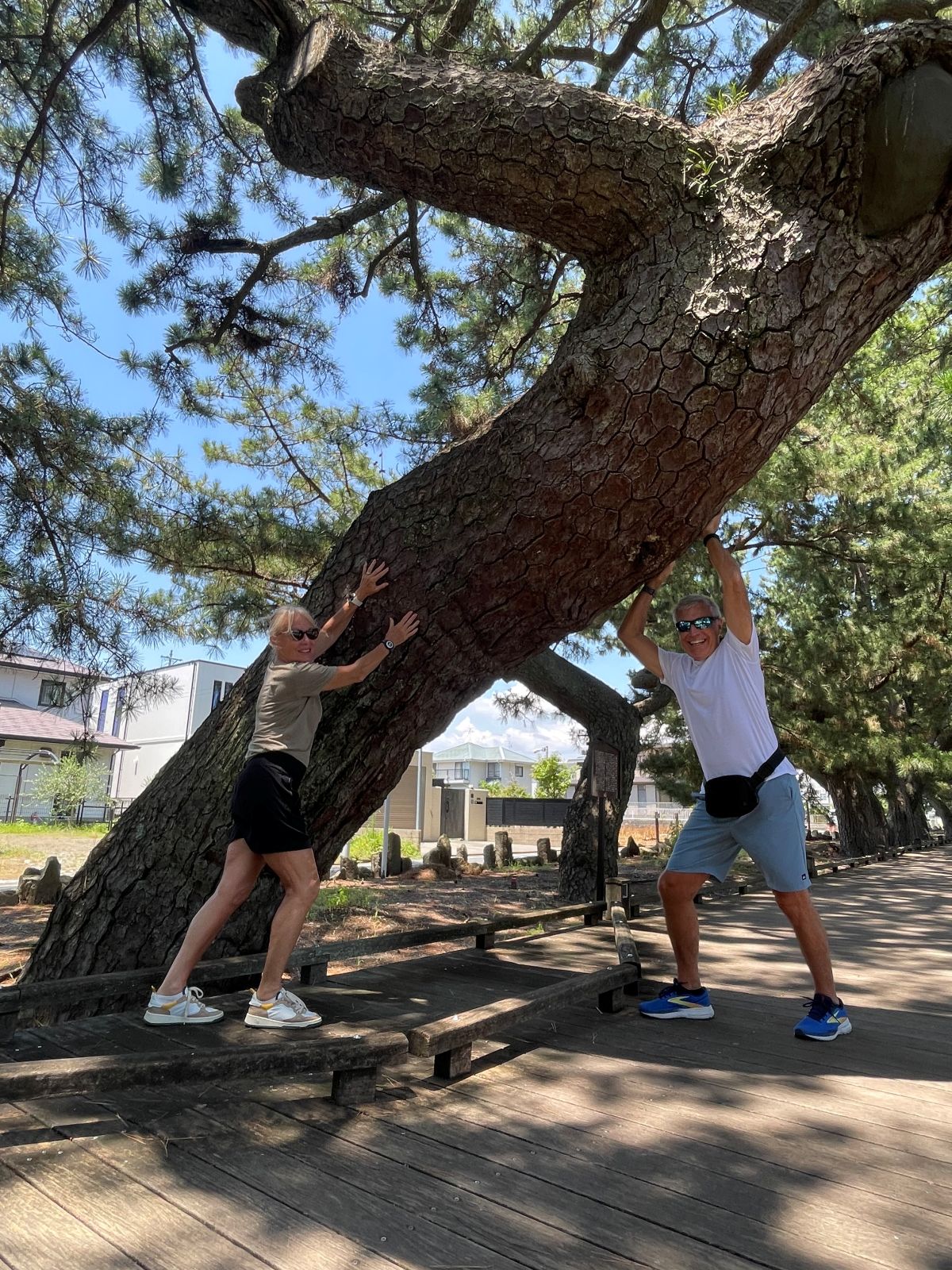
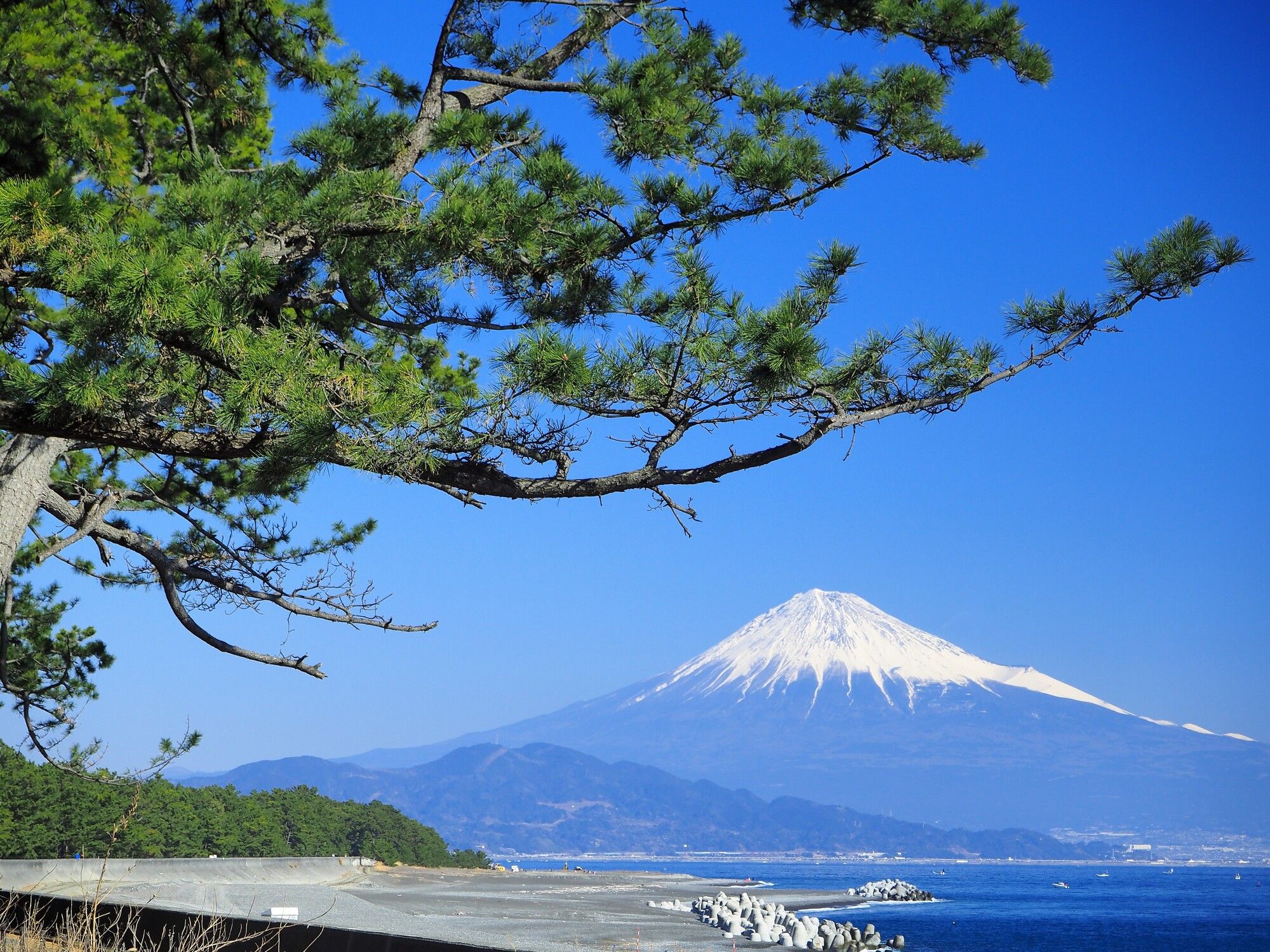
Miho no Matsubara, a three-kilometre pine grove curving along a sand spit south of the port, earned its UNESCO World Cultural Heritage designation as part of the Fujisan inscription — the ancient pines have framed Fuji's reflection in the bay for so long that they appear in the oldest known illustrated scrolls of the mountain. The grove is unhurried, uncrowded outside peak autumn colour season, and genuinely atmospheric: salt wind moves through the canopy, fishing boats anchor offshore, and the mountain fills the western sky when conditions are clear.
At Shimizu Fisherman's Wharf and the adjacent Sushi Alley (referred to locally as Kashi no Ichiba), the tuna culture comes into focus. Shimizu lands tens of thousands of tonnes of Pacific bluefin and bigeye tuna annually, and the neighbourhood's sushi counters source their fish from boats that docked the same morning. Sitting at a compact hinoki-wood counter and watching a itamae slice a single loin into precisely fanned cuts of toro or akami is one of those quietly instructive pleasures that Japan does better than anywhere.
Top things to do in Shimizu on a cruise stopover
Hakone Ropeway and Owakudani Volcanic Valley
The Hakone Ropeway carries passengers in gondolas over the active volcanic zone of Owakudani — a landscape of sulphurous steam vents, bare grey hillside, and a persistent smell of hydrogen sulphide that makes the geological reality impossible to ignore. The ropeway stretches 4 kilometres between Sounzan and Togendai stations, crossing the caldera rim and descending to Lake Ashi; on clear days, Mt. Fuji is visible directly ahead for most of the crossing — a view that appears almost composited in its perfection. Owakudani itself is reached at the midpoint station, where fumaroles have been active since the last major eruption of the Hakone volcanic system 3,000 years ago. The local speciality — kuro tamago (black eggs hard-boiled in the sulphur springs) — is sold at stalls near the vents; the shells turn black from iron sulphide deposits, and local legend holds that eating one adds seven years to your life.
Lake Ashi Cruise: Fuji, Water, and Forested Caldera
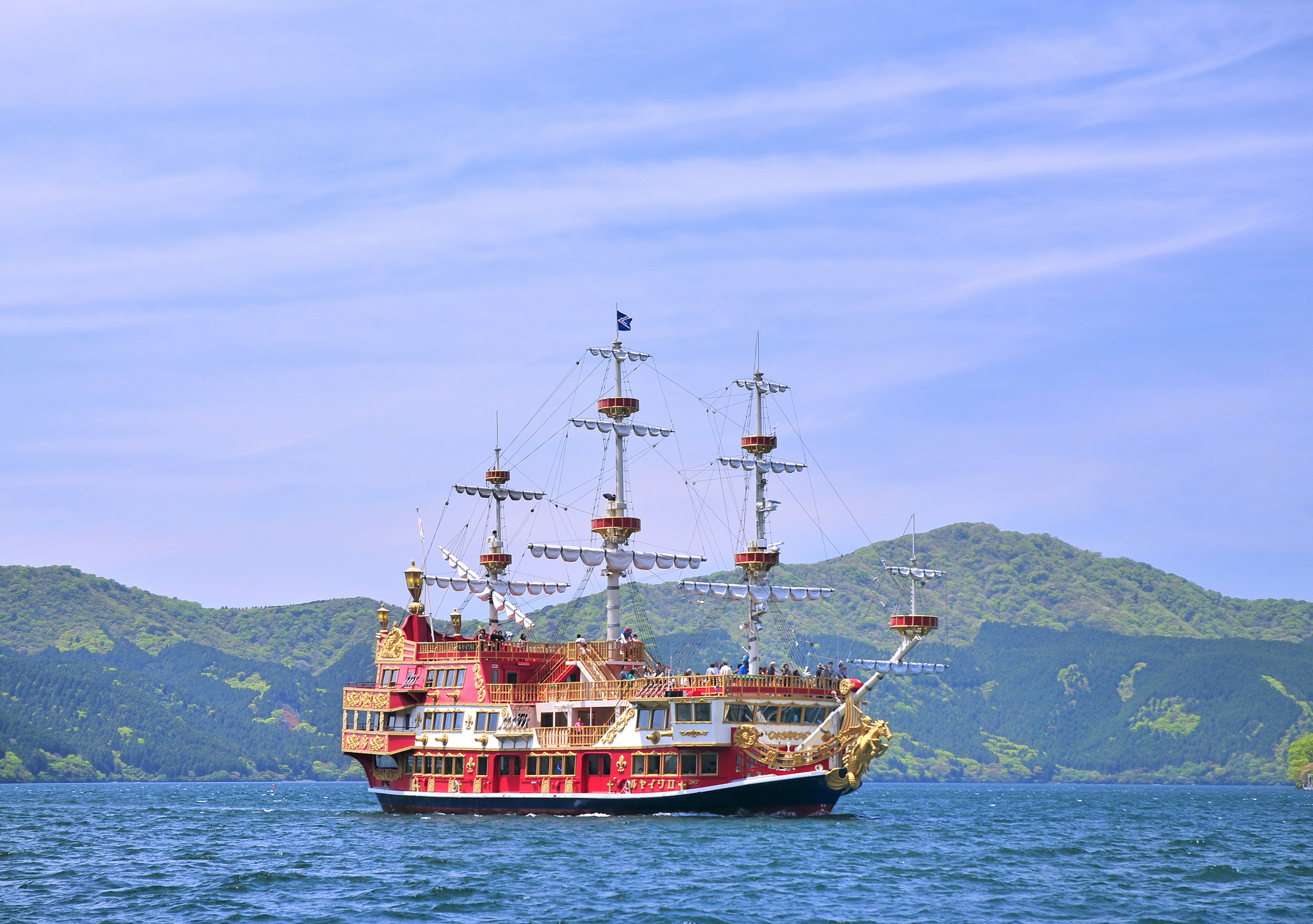
Lake Ashi occupies the flooded caldera of the ancient Hakone volcano and sits at 723 metres above sea level, surrounded by forested peaks that contain it like a natural amphitheatre. The cruise across the lake — operated by traditional-style pirate ships between Togendai, Hakonemachi, and Moto-Hakone — takes approximately 30 minutes end to end and provides the classic composition of Japanese landscape art: Mt. Fuji rising above the caldera rim on the northwest horizon, its reflection shimmering in the lake when conditions permit. The Hakone Shrine torii gate at Moto-Hakone stands in the lake's shallows on the southern shore — red-lacquered wood rising from the grey water — and is visible from the ferry as you approach the landing. Morning cruises typically see the best weather and the highest likelihood of Fuji visibility; cloud cover builds from the south through the afternoon.
Hakone Shrine and the Cedar Avenue
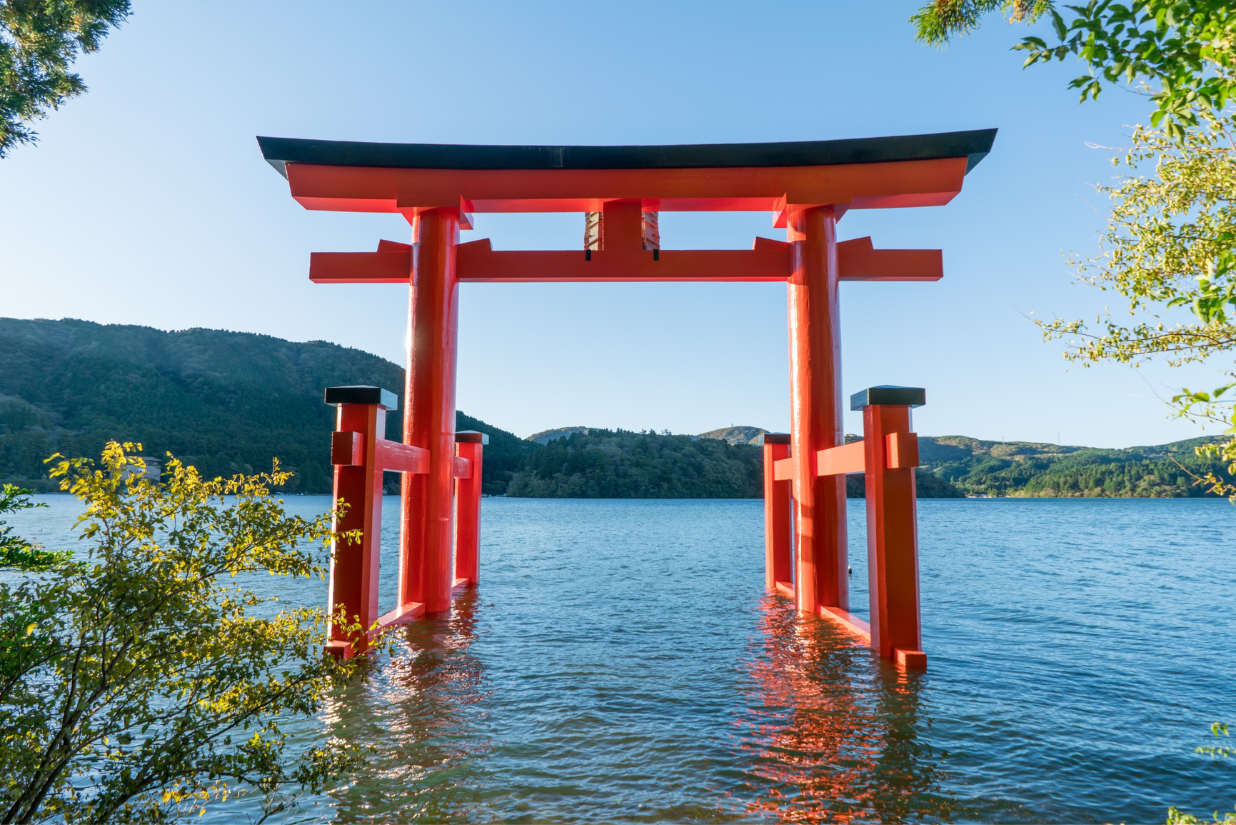
Standing at the water's edge on the southern shore of Lake Ashi, Hakone Shrine has been a place of worship since the 8th century and served as a guardian shrine for travellers crossing the Hakone mountains on the Tokaido road — the major route connecting Edo and Kyoto. The approach from the highway runs through a corridor of towering cryptomeria cedar trees whose trunks are centuries old and whose canopy blocks the light to the path below, creating a transitional space — a threshold — between the ordinary world and the shrine precincts. The famous lakeside torii gate stands slightly apart from the main shrine complex, its feet in the water, and is the most photographed element: a red column rising from the dark lake, with the forest behind and the mountains beyond. The main shrine building is more modest than its setting suggests, with a honden (inner sanctuary) visible behind wooden lattice screens and guardian lion-dogs (komainu) flanking the approach.
Mt. Fuji: Japan's Sacred Mountain on the Horizon
At 3,776 metres, Mt. Fuji is Japan's highest peak and has been regarded as a sacred mountain since at least the 7th century — a site of Shinto worship, Buddhist pilgrimage, and the symbolic centre of Japanese visual culture across centuries of woodblock printmaking. From the Hakone highlands and Lake Ashi, Fuji is visible to the northwest as a solitary, near-perfectly symmetrical cone rising above the surrounding hills — the classic profile that Hokusai captured in his Thirty-six Views and that remains one of the world's most immediately recognisable mountain forms. The best visibility occurs between October and February, when cold fronts clear the lower atmosphere; summer months (June–August) bring humidity and cloud cover that obscure the summit for days at a time. The mountain is close enough to Shimizu port that views can also be had from the port area on exceptionally clear days.
Kunozan Toshogu Shrine and Shizuoka Heritage
Kunozan Toshogu is the original burial shrine of Tokugawa Ieyasu — the shogun who unified Japan in 1603 and established the Edo Period governance that lasted until 1868. Built in 1617, one year after Ieyasu's death, the shrine predates the more famous Nikko Toshogu and represents the first and most personally significant of the memorials to the Tokugawa founder. The complex is reached either by the Nihondaira ropeway from the plateau above the coast or by climbing 1,159 stone steps from the Suruga Bay approach — a path that passes through camphor and cedar forest before arriving at the elaborately carved and lacquered gate complex. The shrine buildings are designated National Treasures: their surfaces are covered in detailed carvings of birds, flowers, and mythological figures picked out in red, black, and gold against a deep green hillside backdrop.
Shimizu Port: Sushi, Tea, and the View of Suruga Bay
Shimizu port is not only an industrial gateway — it is the working harbour of a city that takes its food seriously. The Kashi no Ichiba fish market complex adjacent to the port contains Sushi Alley (Sushi Yokocho), a row of counter-seating restaurants specialising in the ultra-fresh sushi made possible by a tuna auction that supplies the stalls directly. Shimizu tuna — particularly the Pacific bluefin (honmaguro) landed by local vessels — has a reputation among Tokyo buyers that translates to exceptional quality at source. Suruga Bay, which the port faces, is the deepest bay in Japan at 2,500 metres and supports fisheries for sakura shrimp (sakuraebi), a species caught only in this bay worldwide — dried, served in tempura, or scattered over rice dishes as a pink garnish.
Shimizu travel tips
Check Fuji visibility the night before. Mt. Fuji is cloud-obscured more than 200 days per year, and summer is the worst season. If your ship has Wi-Fi, check the Mt. Fuji Webcam (fujisan-3776.jp) or any Japanese weather app for Shizuoka ken visibility reports the evening before arrival. If the forecast is cloudy, recalibrate your day toward the tuna market and Kunozan Toshogu rather than viewpoint-focused sites. Miho no Matsubara remains beautiful regardless, but the pine grove without Fuji in the background is a different, more intimate experience.
Arrive at Sushi Alley early — and eat before noon. The sushi counters at Kashi no Ichiba begin filling between 10:30am and most sell out of prime cuts by 1pm. If your ship docks at 8am, head directly to the wharf before any other activity. Many counters open at 10am; arriving just before opening means you'll have the chef's full attention and first choice of the morning's tuna. Bring cash — 2,000–4,000 JPY per person is typical for a satisfying sushi lunch at Sushi Alley.
Use Shizuoka IC card or buy train tickets in advance. If you plan to travel to Shizuoka city by JR train, the TOICA or Suica IC card (preloaded transit card) makes boarding faster and avoids ticket-machine queues. These can be loaded at any JR station vending machine with a foreign credit card. If you don't have an IC card, the Shimizu–Shizuoka JR fare is inexpensive (about 320 JPY) and machines have an English-language mode.
Dress for temple stairs and coastal wind. Kunozan Toshogu's 1,159 steps are steep and unevenly spaced; wear shoes with grip. The ropeway avoids the steps but lands at the top only — you still descend on foot or retake the ropeway. Miho no Matsubara involves walking on sand and uneven pine-root paths. The coastal bay position means wind can be sharp even on warm days. A light layer and flat, closed shoes serve most Shimizu itineraries well.
Learn two phrases — they open doors. Japanese shopkeepers and restaurant staff respond warmly to any effort at the language. 'Kore wa nan desu ka?' (What is this?) accompanied by pointing works at any market counter. 'Oishii desu!' (It's delicious!) after tasting something produces genuine pleasure in the person who prepared it. These two phrases plus basic numbers (ichi, ni, san) will carry you through most port-day interactions in Shimizu more effectively than any translation app.
Allow buffer time — Japanese transit is precise but transfer points take time. Japanese trains run on the advertised minute, which is a comfort, but walking between platforms, buying tickets, and navigating unfamiliar station layouts takes longer than it looks on paper. For a ship with a 6pm departure, plan to be back at Shimizu Station by 5:15pm at the latest. If you're visiting Nihondaira, note that the last ropeway down to Kunozan runs at a set time — confirm the schedule on the day, as it changes seasonally.
Port Facts Every Cruiser Needs To Know
Shimizu shore excursion FAQs
Mt. Fuji's summit is approximately 65 km from Shimizu port by road, and the mountain itself is visible from the port and surrounding viewpoints on clear days. During the official climbing season (early July to early September), the fifth station on the Fujinomiya route — the closest to Shimizu — is accessible by bus from Shin-Fuji Station (about 90 min from Shimizu by JR). However, attempting the summit on a cruise port day is not realistic: the return climb takes 7–9 hours and weather above the fifth station is unpredictable. For port visitors, the mountain is best experienced from Miho no Matsubara or Nihondaira Plateau rather than attempted as a hike.
Shimizu and Shizuoka are navigable for non-Japanese speakers with moderate effort. Major train stations have English-language ticket machines and English signage on platforms. Tourist sites including Miho no Matsubara, Nihondaira, and the wharf area have English information boards. Google Translate's camera mode handles menus and signs reliably. The main practical challenge is the taxi — drivers rarely speak English, so showing a printed or phone-screen address in Japanese characters avoids confusion. The Shimizu tourist information centre near the station can assist with basic inquiries in English.
Miho no Matsubara was inscribed in 2013 as part of the Fujisan World Cultural Heritage Site, recognised not simply as a scenic viewpoint but as a site that has shaped Japanese cultural and artistic expression for over a millennium. The pine grove appears in the oldest surviving illustrated manuscripts depicting Fuji, in hundreds of Edo-period woodblock prints (including Hokusai's series), and in classical poetry. UNESCO's inscription acknowledged the grove's role in forming the Japanese aesthetic concept of ma — the meaningful space between objects — where the pines, sea, and mountain are understood as a composed visual relationship rather than separate elements. The site thus represents living cultural continuity as much as natural beauty.
While tuna sushi is the signature experience, Shizuoka cuisine is broader. Sakura shrimp (sakura ebi), small translucent shrimp harvested only in Suruga Bay, appear in tempura, kakiage fritters, and dried on rice bowls — look for them at the wharf market and local restaurants, particularly in spring and autumn when the fishing season peaks. Shizuoka oden — a local style of the simmered one-pot dish served with a distinctive dark broth and powdered dried bonito on top — is sold at covered market stalls in the city. Wasabi grown in the cold mountain streams of the Abe River valley is another local speciality; fresh-grated wasabi on a small wooden board served beside sashimi is a very different experience from the paste found internationally.
Yes. Shimizu's food culture extends well beyond raw seafood. The Fisherman's Wharf area includes restaurants serving grilled fish, fried seafood, and cooked tuna dishes (particularly tuna steak and tuna noodle soups). Shizuoka city's covered shopping arcade has ramen shops, tonkatsu (crumbed pork cutlet) restaurants, and multiple wagashi (Japanese sweet) shops where confections paired with tea are the focus. Tea houses throughout the region offer a food experience centred on sweets and brewing rather than fish. For travellers with dietary restrictions, vegetarian Buddhist temple cuisine (shojin ryori) can be arranged with advance notice at some traditional restaurants near Kunozan.
No. The local trains between Shimizu and Shizuoka operate on the Tokaido Line and are inexpensive (approximately 320 JPY one way). A Japan Rail Pass can be used on JR trains here, but if you only have a pass for this one day and it's not already purchased, it's not worth buying one for Shimizu alone. Simply purchase single-journey tickets from the station machines (which have English-language modes) or load an IC card (Suica or TOICA) with yen. IC cards work on both JR and Shizutetsu (private railway) lines and on local buses.
The conditions matter more than the location. Given the right weather — cold, dry air with no cloud cover — Fuji is visible from multiple points around Shimizu: the port pier itself, the beach at Miho no Matsubara, and the Nihondaira Plateau all offer unobstructed views. Photographers specifically seek Miho no Matsubara for the classical composition (pines in foreground, mountain across water) and the early-morning light that falls on Fuji's eastern face. Nihondaira offers the widest panoramic view. For the bay reflection of Fuji in glassy water, a clear calm morning at Miho no Matsubara before 9am is the optimal combination. In all cases, confirm visibility before making viewpoints the centrepiece of your day.
Yes, with specificity. Shizuoka tea makes an exceptional and lightweight souvenir; specialist tea shops in both Shimizu and Shizuoka city will vacuum-seal purchases for travel. Fresh wasabi paste (in a tube) and wasabi products are shelf-stable and travel well. The wharf market sells dried sakura shrimp in sealed packets — intensely flavoured and lightweight. For crafts, Shizuoka is the centre of Japan's fine woodworking and wooden furniture tradition; lacquerware and small wooden objects from workshops in the city represent genuine local craft. Avoid generic omiyage (souvenir confectionery) sold at convenience stores near tourist sites, which is largely the same across Japan.
The port wharf area and Fisherman's Wharf market are flat and accessible. Shimizu and Shizuoka train stations have lifts and step-free access. Miho no Matsubara's main path is flat packed sand — manageable for many mobility aids, though uneven in places near the beach. Nihondaira Plateau is reachable by bus and has paved viewpoint areas, but Kunozan's 1,159 steps are inaccessible to wheelchair users — the ropeway provides the only accessible alternative, and even that requires some steps at each end. Kunozan Toshogu shrine buildings themselves have some steps. It is worth contacting Shizuoka prefecture tourism in advance for current accessibility information at specific sites.
Rain is common in Shimizu, which sits in a bowl of geography that catches both Pacific moisture and mountain weather. A rainy day actually shifts the experience productively: the tuna market and Sushi Alley are fully covered and atmospheric in any weather. Shizuoka city's covered shopping arcades make for comfortable walking. The Shizuoka City Museum of Art and the Sumpu Museum (focused on Edo-period craft and Tokugawa-era history) are worthwhile indoor alternatives. Tea house visits — sitting quietly with a bowl of matcha and a wagashi sweet while rain falls on a garden — are one of those experiences that rainy days actually improve. Postpone Miho no Matsubara and Nihondaira to a future clear-day port call if possible.
Filters
Select a filter to refine results.
Tour Type
Tour Activity
 Cart
Cart
 USD
USD GBP
GBP AUD
AUD EUR
EUR CAD
CAD